
Out of a tube and into the clubs
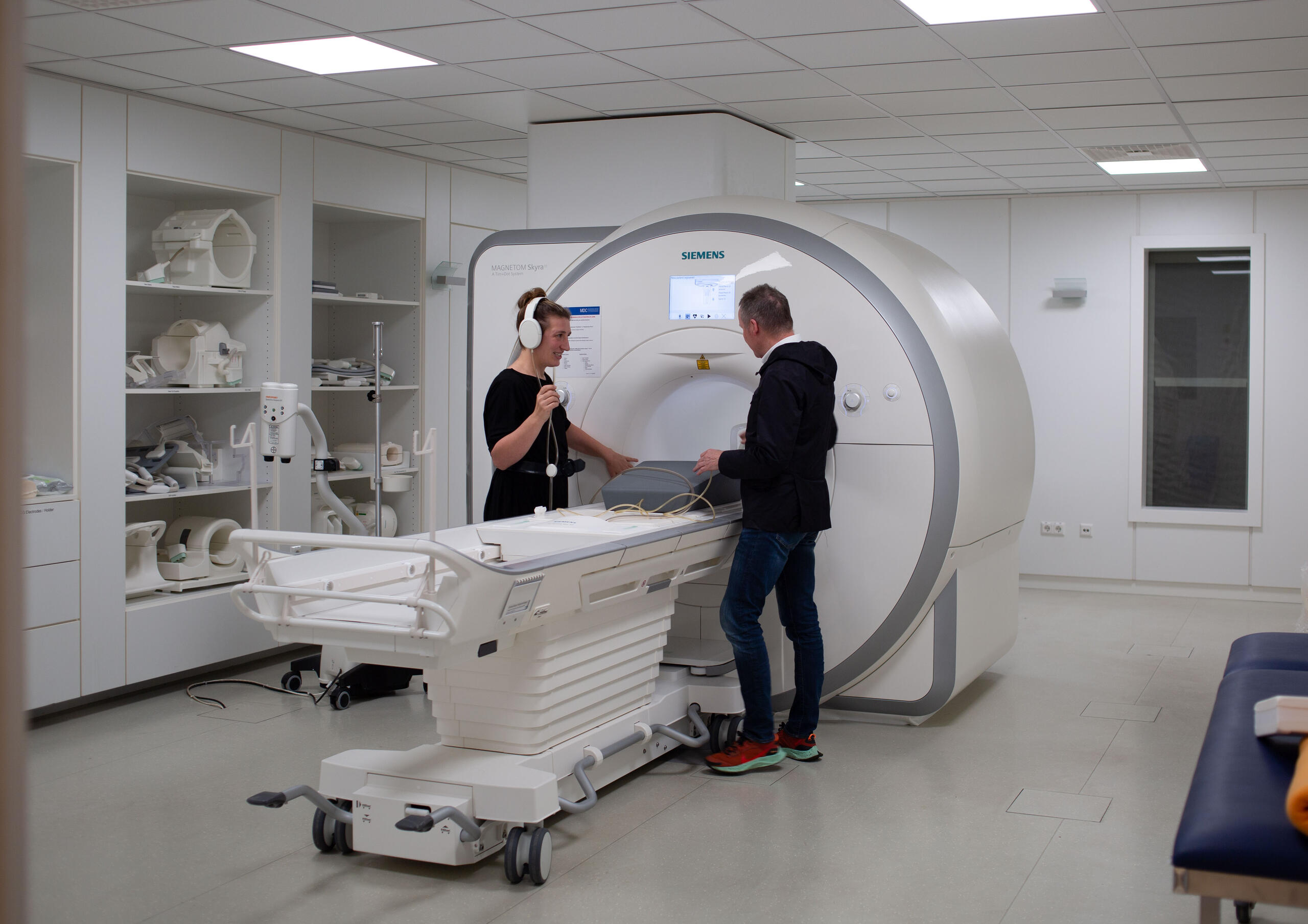
For most people, magnetic resonance imaging (MRI) is an unpleasant procedure — and not only because of the prospect of detecting a potential tumor or other injury. The experience itself can be unnerving. One is confined to a tube and must lie motionless for at least a quarter of an hour. Additionally, the machine makes rhythmic thumping noises, which reach peak levels of around 120 decibels, making them louder than a busy highway — and striking fear into the hearts of people undergoing the procedure.
There are probably very few people who associate these sounds with techno music or wild dance clubs. But perhaps that’s exactly the way to alleviate people’s fears and help them realize the benefits of the procedure? Johanna Barnbeck, an expert in audiovisual science communication, is confident that this strategy — inspired by a TikTok video and her own experiences with MRI scans — can work.
She approached Dr. Thoralf Niendorf, Group Leader of Experimental Ultrahigh-Field MR at the Max Delbrück Center, with her idea, and then the Stiftung Charité. The foundation is now supporting the joint project “MRI Techno – Artistic and Scientific Encounters in k‑Space” as one of three “science x media tandems” with just over €100,000 through November 2027. The goal of the funding program is to explore new avenues of science communication and, in doing so, to develop content and formats that have an impact beyond Berlin’s life sciences community.
Ringtones and on-hold music
“Together, we will explore strategies to bridge the gap between abstract medical imaging, fear of medical procedures, and everyday culture,” says Barnbeck. “Through artistic approaches, we want to open new perspectives — for patients, medical professionals, researchers, and artists.”
Johanna Barnbeck and Thoralf Niendorf
In a collaboration with these groups, Barnbeck and Niendorf aim to create music, visuals, and art installations from the sounds and images of MRI scans. “The k‑space — in medicine, a data grid containing the original MR signals measured by the scanner — represents for us a place of encounter, transformation, and new possibilities for artistic and scientific expression; in short, a space for communication,” says Barnbeck, explaining the title of their project.
For his part, Niendorf is stepping into a new world. “Until now, I didn’t really have much of a connection to techno,” he says. Nevertheless, the project immediately appealed to him and he is very curious to see how it develops. The rhythms from the MRI scanner should make their way into Berlin’s clubs, says Barnbeck. “Maybe even to the Charité, as ringtones or on-hold music.”
Club night and art exhibition
The duo has planned three phases for the project. “In the first phase, we want to invite the groups mentioned earlier to transdisciplinary workshops and explore topics together,” explains Barnbeck. “In the second phase, there will be an open call for participation, via social media or through art and music radio programs.” They have already managed to recruit several well-known DJs and composers for their project. Barnbeck and Niendorf plan to make the knocking sounds from the MRI freely accessible in a sound library on the Max Delbrück Center’s website.
The project’s third phase and grand finale will be a club night and a multimedia exhibition featuring an art installation, for example during the Long Night of Sciences or Berlin Science Week 2027. Visitors will be able to dance to MRI sounds and learn more about the method.
Text: Anke Brodmerkel

Contacts
Dr. Thoralf Niendorf
Group Leader
Experimental Ultrahigh-Field MR
Max Delbrück Center
thoralf.niendorf@mdc-berlin.de
Jana Schlütter
Deputy Head
Communications & Marketing
Max Delbrück Center
+49 30 9406 – 2118
jana.schluetter@mdc-berlin.de or presse@mdc-berlin.de
- Max Delbrück Center
-
The Max Delbrück Center for Molecular Medicine in the Helmholtz Association lays the foundation for the medicine of tomorrow through our discoveries of today. At locations in Berlin-Buch, Berlin-Mitte, Heidelberg, and Mannheim, interdisciplinary teams investigate the complexity of disease at the systems level – from molecules and cells to organs and entire organisms. Together with academic, clinical, and industry partners, and as part of global networks, we turn biological insights into innovations for early detection, personalized therapies, and disease prevention. Founded in 1992, the Max Delbrück Center is home to a vibrant, international research community of around 1,800 people from over 70 countries. We are 90 percent funded by the German federal government and 10 percent by the state of Berlin.


