Virchow 2.0
Berlin Brandenburg innovation cluster for cell-based medicine
Our vision
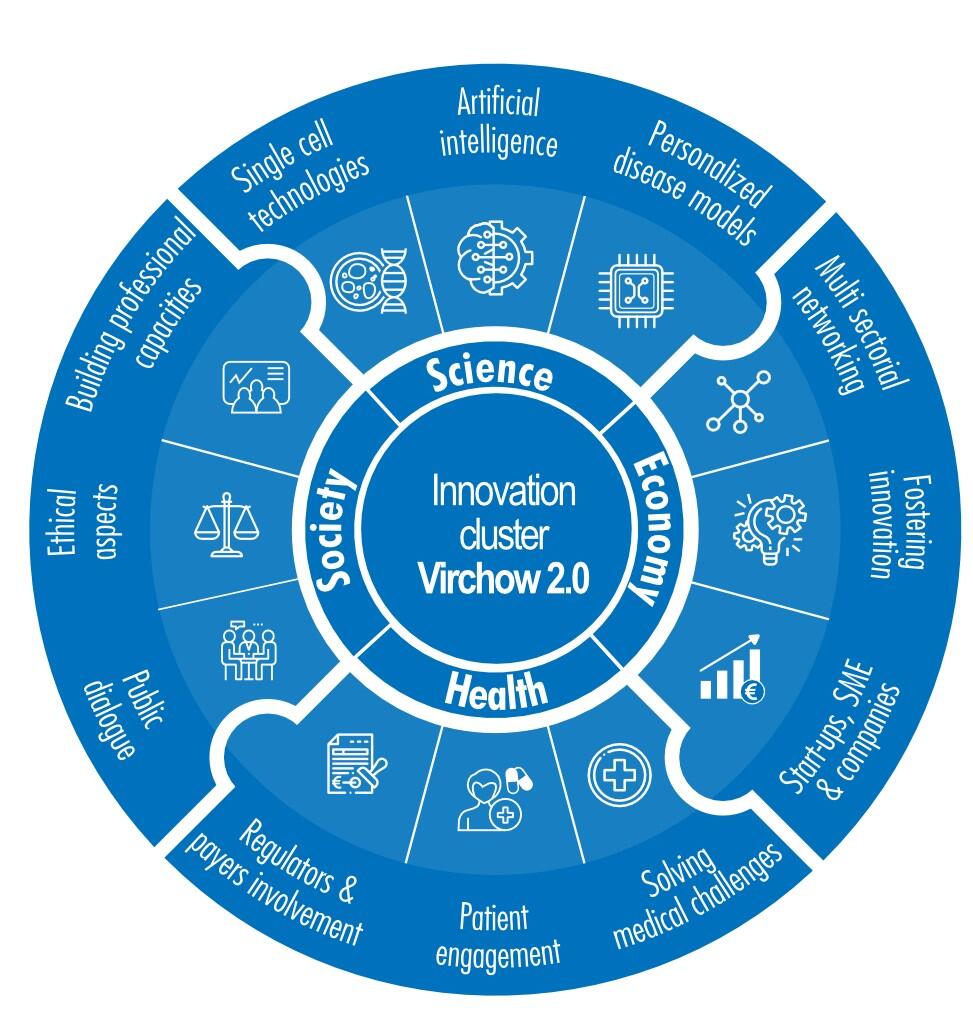
This self-sustaining and evolving ecosystem will bring together various stakeholders ranging from research and technology organizations, industry, society and the clinic to start-up and business development organizations.
The goal is to ensure that the results of cutting-edge research reach citizens directly.
The German capital region is to become a catalyst for the rapid transfer of experimental biomedical and AI developments into innovative products and services for the healthcare industry and thus position itself as an internationally leading pioneer and competitive location in personalized or precision medicine.
Virchow 2.0 is one of the new 15 finalists of the BMFTR Clusters4Future open-topic nationwide competition, which will provide up to 45 million € in funding for each cluster over 9 years to strengthen knowledge and technology transfer by fostering optimal collaboration among different actors from academia, industry and society in a region.
More details are available in the following paper:
Rajewsky, N., Almouzni, G., Gorski, S.A. et al. LifeTime and improving European healthcare through cell-based interceptive medicine. Nature 587, 377 – 386 (2020).
The concept of cell-based interceptive medicine was developed by the LifeTime Initiative.
Our network
Virchow 2.0 is a growing research and innovation network in the German capital region. It brings together a unique constellation of regional players which are global leaders in complementary technology fields.
Experts from systems biology, medicine, biotechnology, physics and computer science/artificial intelligence are teaming up with local and national industry partners to develop world leading single cell analysis tools and methods for tomorrow’s diagnostics and therapies.
If you/your organisation are interested in the Virchow 2.0 community and more information on the development of the cluster strategy during the conception phase (01÷10÷2021−31÷03÷2022), please contact the project coordinator Marie Vidal: marie.vidal@mdc-berlin.de.
- Virchow 2.0 core academic partners
- The competencies of the initial core academic partners are highly synergistic
The Max Delbrück Center contributes cutting-edge innovations in single-cell technologies; the Berlin Institute of Health (BIH) has expertise in efficient biomedical technology transfer; the Charité stands for broad medical expertise and rapid clinical transfer capabilities; the Berlin Institute for the Foundations of Learning and Data (BIFOLD) contributes the required excellence in innovative AI applications.
- Virchow 2.0 project team
-
© Pablo Castagnola
Prof. Dr. Nikolaus Rajewsky
Cluster speaker
Director Berlin Institute for Medical Systems Biology, Max Delbrück Center
Prof. Dr. Angelika Eggert
Cluster co-speaker
Director Pediatric Oncology and Hematology Department, Charité-Universitätsmedizin Berlin

Prof. Dr. Tim Conrad
Director Visual and Data-centric Computing Department, Zuse Institute Berlin, Fellow BIFOLD

Thomas Gazlig
Director Charité BIH Innovation, the Joint Technoloy Transfer of the Charité-Universitätsmedizin Berlin and the Berlin Institute of Health

Dr. Marie Vidal
Cluster project coordinator
Industry and innovation manager Berlin Institute for Medical Systems Biology, Max Delbrück Center for Molecular Medicine
- Associated partners and supporters
- Despite its still very early stage, Virchow 2.0 is already mobilizing numerous stakeholders from academia, industry, politics and society who have pledged their active participation in the cluster. Some 15 pharmaceutical and biotech companies as well as AI start-ups, spin-off projects, foundations and investors, etc. are already supporting the initiative.
- 10x Genomics, Inc.
- Additive Manufacturing Berlin-Brandenburg (AMBER)
- Aignostics GmbH
- ARCAS
- Becton, Dickinson and Company (BD)
- Berlin Partner für Wirtschaft und Technologie GmbH
- BIOTRONIK SE & Co. KG
- Biotx.ai GmbH
- Captain T Cell GmbH
- Cellbricks GmbH
- Cellphenomics GmbH
- CheckImmune GmbH
- Deutsches Rheuma-Forschungszentrum Berlin (DRFZ)
- Einstein Center Digital Future (ECDF)
- EPO – Experimentelle Pharmakologie & Onkologie Berlin-Buch GmbH
- Fraunhofer IZI-BB
- Freie Universität Berlin
- gesund.ai GmbH
- GILUPI GmbH
- Humboldt-Universität zu Berlin
- Illumina, Inc.
- Inflammatix, Inc.
- in.vent Diagnostica GmbH
- Labor Berlin – Charité Vivantes GmbH
- LECO Corporation
- OM-Lot
- Resolve BioSciences GmbH
- RoX Health GmbH
- Scienion GmbH
- Singleron Biotechnologies GmbH
- Stiftung Charité
- Surflay Nanotec GmbH
- Technische Universität Berlin
- TissUse GmbH
- Zymo Research Corporation



Open call
We received 38 applications which were evaluated by external reviewers.
This call for innovative collaboration project ideas opened on 2 November 2021. The submission deadline was Sunday 12 December 2021, 11:59 pm CET.
All information presented on this webpage has been introduced on 8 November during a web-seminar and is available in a video recording. Please also consult the open call FAQs.
VIRCHOW 2.0 Open Call Info Event
Webinar presentation
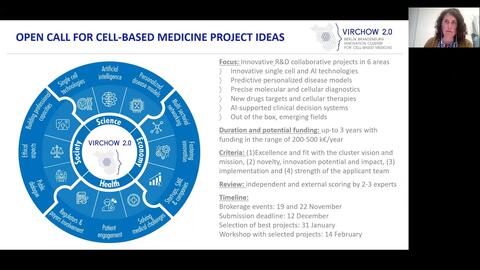
Virchow 2.0: Open Call Info Event
Brokerage event
Monday 22 November 2021 (virtual)
4:00 pm‑5:30 pm
Aim of the call
The objective of the Virchow 2.0 open call is the selection of the best project ideas aligned with the cluster vision of implementing cell-based medicine in Berlin-Brandenburg to integrate them in the final cluster proposal.
Virchow 2.0 invites project teams from academia and industry to propose their collaborative R&D project ideas to be included in the cluster strategy.
Virchow 2.0 is currently in the conception phase as a finalist of the BMBF Clusters4Future competition. Collaborative R&D project ideas selected by the open call will become part of the Virchow 2.0 cluster application. In Mid-2022, the BMBF will announce up to seven Future Clusters that will be supported to implement their concepts for up to nine years. Up to 5 million € in funding is available per cluster and year.
At this stage the Virchow 2.0 open call aims to select the R&D collaborative projects proposed for the three years of the first implementation phase.
Implementing cell-based medicine in Virchow 2.0
Virchow 2.0 is a growing research and innovation network in the German capital region aiming to build a completely novel biomedical AI innovation ecosystem for the implementation of cell-based medicine.
For a few years now, personalized medicine has been at the forefront of the quest for sustainable progress in the treatment of widespread diseases. In this context, cell-based medicine represents a new and promising concept which must be meaningfully developed and integrated into existing structures. This is the goal of Virchow 2.0. At the heart of the cluster are innovative developments building on single-cell technologies with extensive use of artificial intelligence (AI) and new disease models. When combined, these innovations can achieve breakthrough new insights into how and why cells become diseased. This provides the basis for unprecedented precision of molecular and imaging diagnostics in many application areas and the opportunity to revolutionize the discovery of new drug targets and the development of novel therapies. It will efficiently reduce the cost of drug development for the healthcare system and enable the broad application of cell-based medicine with high value-added potential and thus real progress in the treatment of common diseases.
Projects ideas aiming at further developing, integrating and applying single-cell technologies, artificial intelligence as well as patient derived disease models for R&D applications and/or clinical use are welcome.
To find out more about the concept of cell-based medicine, interested potential applicants are encouraged to read the LifeTime Nature perspective article as well as the Strategic Research Agenda of this European initiative.
All applicants who are unsure whether their project is suitable for the Virchow 2.0 cluster strategy are welcome to contact the Virchow 2.0 call managers at opencall@virchow2‑0.de before submitting a proposal to ensure that their project meets the requirements of the call.
Topics
The Virchow 2.0 open call seeks for innovative R&D collaborative project ideas involving academic and industry partners in the following areas:
- Innovative single-cell and AI technologies
This topic calls for technology oriented project ideas aiming to develop further and/or integrate single-cell (multi-)omics and imaging technologies with artificial intelligence and in particular machine learning technologies for R&D applications and potentially clinical use at a later stage. Technology development priorities required for implementing cell-based interceptive medicine are in particular the ones identified by the LifeTime Initiative (see chapter 3 of the LifeTime Strategic Research Agenda: sections Priorities for Developing Next-generation Single-cell Multi-omics and Imaging Technologies p46-49 and Computational Analytics p57-61).
Examples of technology developments which could be proposed under this topic: sensitive, high-resolution imaging- and sequencing-based spatial (multi-)omics technologies, perturbation screens and lineage tracing coupled with single-cell (multi-)omics, multiplexing strategies to increase single-cell analysis high throughput, computational methodologies for data integration of multiple modalities, analytic computational approaches to reveal molecular features and subpopulations hidden behind noise, and ultimately discover links between cell types, phenotypes, and states and their molecular networks
- Predictive personalised disease models
This topic calls for project ideas aiming at developing the next-generation of patient-derived experimental disease models (organoids, human-on-a-chip, advanced animal models containing human genes and cells) and novel predictive computational models of disease. Developing these key technologies in various areas such as the one identified by the LifeTime Initiative (see chapter 3 of the LifeTime Strategic Research Agenda: section Priorities for Developing Next-generation Patient-derived Experimental Disease Models p67-70) will provide experimental models that reflect human biology and pathophysiology as closely as possible. These can then be used to understand disease molecular mechanisms at the cellular level and iteratively test AI and machine learning-based computational models that predict outcomes or most effective treatments for an individual patient.
Examples of technology developments which could be proposed under this topic:
increasing cellular, structural and functional complexity of organoids (vascularisation, innervation,immune compartment, etc.), organoid integration to study tissue-tissue and organ-organ interactions, standardisation, automation, scaling and benchmarking of organoid propagation and banking, generating computational predictive models based on patients’ cellular trajectories- Precise molecular and cellular diagnostics
This topic calls for project ideas aiming at integrating and applying combination(s) of single-cell, AI technologies and patient derived disease models to identify biomarkers and develop precise diagnostics on the basis of mechanistic, cell-based understanding of disease.
Examples of technology applications which could be proposed under this topic:
Identification of diagnostic, prognostic, or predictive biomarkers by AI-assisted single-cell analysis in minimally invasive liquid biopsy, development of next generation screening for early disease detection and/or therapy monitoring- New drugs targets and cellular therapies
This topic calls for project ideas aiming at integrating and applying combination(s) of single-cell, AI technologies and patient derived disease models for the discovery of more reliable drug targets and/or the development of cellular therapies (cell‑, gene‑, RNA-therapy, etc.)
Examples of technology applications which could be proposed under this topic:
AI-supported spatial omics technologies to localize diseased cells in tissues and precisely describe cell functionalities thereby establishing causality for molecular mechanisms and identification of new therapeutic targets, development of new cell-specific therapeutic concepts such as sequential immunotherapy or cell-therapy to modulate specific cell types or deliver targeted modifications- AI-supported clinical decision systems
This topic calls for project ideas aiming at developing software-based AI tools that can assist physicians, nurses, patients, or other care-givers in clinical decision-making.
Examples of technology applications which could be proposed under this topic:
Novel diagnostics software products (e.g. integrated omics‑, imaging and network analysis) for the identification of the best therapy for the individual patient; digital pathology with explainable AI applied to spatially resolved single-cell data in combination with medical imaging data- Out of the box, emerging fields
This topic calls for technology development and application projects which do not fit in one of the above categories.
Surprise us!
Eligibility requirements
Scope: Applications must propose cell-based medicine collaborative R&D project ideas involving partners from academia and industry.
Most proposals will have to include industry partner(s), project ideas without industry contribution can only be considered, if overall the cluster budget secures 20% own contribution from its partners (see co-funding below).
Project team: Only consortia of a minimum of two partners from two different organizations are eligible; a single applicant cannot apply.
Please see the section match-making opportunities, if you are looking for a project partner.
Co-funding: Overall the cluster budget has to secure 20% of own contribution from its partners and industry partners are expected to commit to co-funding of their project costs. For more details, please consult the Clusters4Future guidelines from the BMBF, in particular section 5 as well as section 2 of the annex as well as our budget plan guidelines.
Regionality: All partners are expected to be regional to Berlin-Brandenburg. Exceptions may be granted, if well justified (e.g. no local partner exists). However, only partners from Germany are eligible for BMBF funding and only contributions of German organizations count towards the overall own contribution of the cluster. International partners are welcome as associated partners if they cover their own costs but they cannot receive BMBF funding and their contribution doesn’t count towards the overall own contribution of the cluster.
Availability for strategic planning of Virchow 2.0: Applicants must be willing and available to participate in an in-person Virchow 2.0 strategy workshop on February 14, 2022 with partners of all selected project teams and present their submitted project idea. Selected applicants must be willing and available to support the Virchow 2.0 conception phase team in preparing the final Virchow 2.0 cluster proposal, especially regarding all matters related to their project idea.
Application signature: Signatories must have the appropriate decision power within their organisation to submit the proposal (e.g. a post-doc from an academic group can participate if their supervisor is signing the application).
Application number: The number of applications per partner and per consortium is not limited.
Process and timeline
Submissions are accepted exclusively to the email address opencall@virchow2‑0.de. Please submit your project idea application as a single pdf including all required documents. The application must be signed by each involved applicant. The required proposal template as well as the signature page can be downloaded from this webpage (see links below).
For questions concerning the open call, please contact the open call managers at opencall@virchow2‑0.de.
Key dates
The Open Call for projects ideas launches on 2 November 2021
The submission deadline is 12 December 2021
Applications will be reviewed and the decision announced by 31 January 2022
A workshop with partners of all selected project ideas is planned on 14 February 2022
The final Virchow 2.0 cluster strategy including description of the selected projects has to be submitted by 31 March 2022
The BMBF will announce the supported clusters in the middle of 2022
The first 3‑year implementation phase is expected to start in early 2023
Selection criteria
All project ideas will be evaluated based on the following criteria:
Excellence of the hypothesis/aims for the cluster strategy: Preference will be given to project ideas that are (1) scientifically sound and comprehensive and (2) relevant for the Virchow 2.0 strategy. Alignment with the cluster vision of implementing cell-based medicine in Berlin-Brandenburg is a key criteria
Innovation potential and impact: Preference will be given to proposals that (1) demonstrate a clear understanding of the problem(s) they are trying to solve; (2) clearly outline the novelty of their approach to solving the problem(s); (3) define the expected societal and/or economic impact and present a promising path to patient and/or marketability/probability of commercialization
Implementation: Preference will be given to proposals that have (1) clearly defined objectives, relevant to the hypothesis; (2) a work plan achievable within the scope of the project with appropriate milestones and budget; (3) identify potential challenges and pitfalls
Strength of the applicant team: Preference will be given to proposals with applicants who have the necessary competencies, expertise and network to implement the project idea
Duration and potential funding
Project ideas with a duration of maximum three years can be submitted. There is no limit to the budget that can be requested per application or applicant. However, it is reasonable to consider the indicative range of 200 to 500K€ per year for a project budget.
Please note that this is not a call for project funding yet. The selected projects will be included in the final cluster proposal and will receive funding only if Virchow 2.0 is chosen by the BMBF to realize its first implementation phase. Up to 4.5 million € would be available per year for all R&D collaborative projects in the cluster.
Matchmaking opportunities
Do you have an innovative idea and are you looking for a specific complementary expertise? Do you need additional partner(s) to develop your project proposal?
⇒ Join our growing network on the Virchow 2.0 matchmaking platform
On this website, you will be able to
- create/update your profile to present your expertise and interests
- search for partners and book meetings with other Virchow 2.0 match-making participants
- register to join our virtual brokerage event scheduled on
Monday 22 November, 4:00 – 5:30 pm CET
and submit your project idea pitch by 12 November 2021
For consulting on demand with Open Call managers, write to opencall@virchow2‑0.de.
Downloads and further information
Application package
Further information
Events
- Kick-off event Virchow 2.0
- 27 Sept 2021 | Hybrid – Langenbeck-Virchow Haus, Berlin
On behalf of all partners behind the initiative, we are delighted to invite you to the very first meeting of the cluster project Virchow 2.0 on Monday 27th of September 2021, in Berlin.
- Cluster meets | Virchow 2.0 – implementing cell-based medicine in Berlin
- 26 May 2021 | Virtual
Prof. Nikolaus Rajewsky, Scientific Director of the Berlin Institute for Medical Systems Biology (BIMSB) at the Max Delbrück Center for Molecular Medicine (MDC) in the Helmholtz Association and Prof. Angelika Eggert, Director of the Department of Pedriatric Oncology and Hematology at Charité – Universitätsmedizin Berlin will give insights into their current research and introduce initial steps towards Virchow 2.0 and the establishment of the Berlin Cell Hospital. In particular they will present a recently submitted proposal for the BMBF “Clusters4Future” initiative and further possibilities of collaborations.