
Postdoc Career Track Program
ASPIRE supports the career development of our postdocs
Aspire
Researcher development is among our highest priorities. In this context, promoting junior researchers’ early independence and supporting non-academic career paths were identified as key goals for improving postdoctoral support.
The next round of the ASPIRE program will start in January 2025.
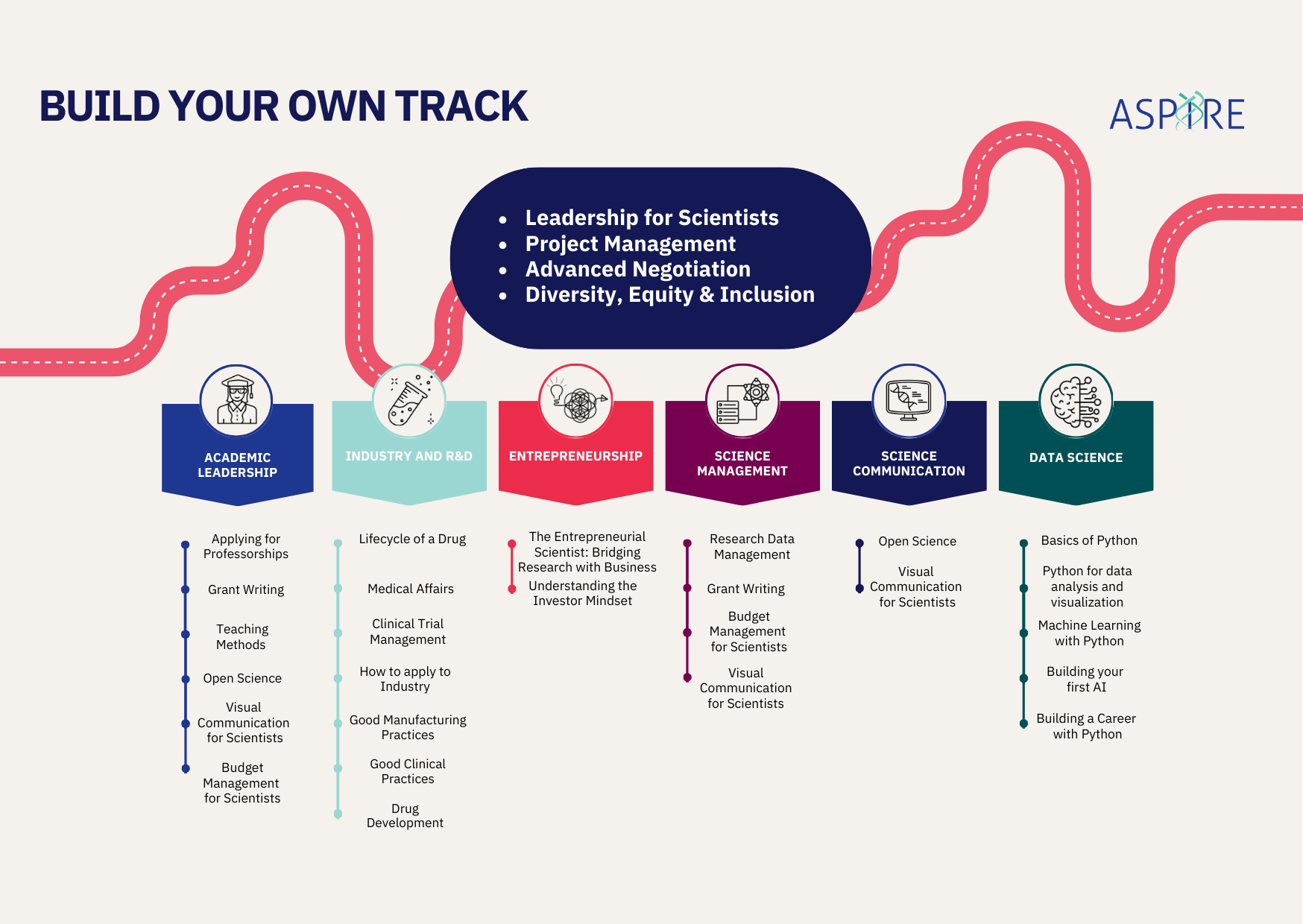
ASPIRE is offering a new format of structured support and training in six main career trajectories:
Core
Leadership for scientists
The course focuses on strategies and tools to navigate the challenges of a career following the time at the Max Delbrück Center. The participants will:
- improve their communication, collaboration and leadership skills
- understand how to reach academic career goals:
- more efficiently ( doing things right)
- more effectively (doing the right thing)
- identify strategies to establish themselves in their desired career track
- learn how to build and maintain a trustful and open group culture
- learn and practice useful tools to succeed in the ASPIRE career tracks
- be encouraged to establish and maintain a peer support group
- strengthen their professional network within and outside of the MDC
Project management
The participants will learn pragmatic, professional methods which will tangibly ease their work as project leader. The course will help them as a project leader to achieve higher level of confidence, to use their time more efficiently, to replace chaos with structure, to stick to plans more effectively and to gain the recognition that they deserve for their project work. This will enable them to complete projects within the given time and budget, and in accordance with quality specifications.
Advanced Negotiation
Negotiation is far more than deal making. It is a structured, professional form of communication which we are likely to use frequently in our work environment and in particular for career progression inside or outside of academia. In this course we will provide a framework and practise how to prepare and conduct negotiations in an effective and assertive way.
In this practical workshop, participants will learn how to:
- position themselves strategically in the best possible position within their organisation
- evaluate their own and their partner’s interests
- reach better results in negotiations with partners and suppliers
- maintain solid and sustainable relationships with collaborators and co-workers
- be more comfortable when proactively asking for things
- transform conflicts into solutions of mutual benefit
Diversity, Equity and Inclusion
In this Follow-Up to the Leadership and Management Skills Course, we will reflect on Diversity, Equity and Inclusion in the research setting and highlight its benefits for the research process, team productivity, as well as individual development and success. Through raising awareness and providing concrete and applicable tools, we will empower participants to influence building an inclusive culture in existing and future teams.
Goals
- Understand what Diversity, Equity, and Inclusion really means and how it benefits science
- Gain awareness of common biases in the workplace and how to constructively counteract them
- Learn tools to recruit and build a diverse team
Topics
- Reflecting on own practices
- Counteracting unconscious biases
- Driving equity in recruitment
- Developing your personal DEI mission statement
Academics
Many postdoctoral researchers aim to become experts in their field, rather than becoming leaders. An academic leadership position, however, requires additional skills and competences that will determine the productivity and success of the working group.

In this track, participants will have the possibility to acquire knowledge not only in the financial questions of the academic world, but also in the maintenance and establishment of a good and effective work environment.
- What skills do I need and what will I learn?
Leadership qualities might be hard to define, but high in demand and helpful when pursuing a career in academia. In order to succeed in an academic career, not only a strong publication record is important, but also a series of key skills:
- Strong vision: resilience, passion, persistency, commitment and dedication.
- Communication skills: ability to communicate ideas effectively and engage with the ideas of others.
- Proactivity: be prepared for the worst while still hoping, planning and staying positive
- Translational skills: listening to people, understanding their needs and knowing how to motivate a team.
In this track, the participants will learn to reflect on their personal leadership style, and techniques to develop it according to their goals. The topics covered include preparation for an independent position, grant writing, applying for professorships, creating partnership with industry and teaching. The participants will also have the opportunity to sit on young group leader recruitment committees and prepare an application for a young group leader position where they will get feedback from the faculty.
- Roles and responsibilities of Academic Leaders
The main role of an academic leader is related to their research in their area(s) of expertise and/or that of a faculty member. Responsibilities of this role include teaching, developing curricular programs and courses, advising and mentoring students, participating on examination committees and seeking research funding.
Likewise, academic leaders can often be involved in the administration of the department they belong to. They take on the role of advocates for their department’s interests, being responsible for the creation of a supportive and productive work environment, encouraging outreach, coordinating relationships with external partners, participating in governance committees and tasks forces, and preparing budgets.
- Workshop overview
The workshops in this track provide fundamental knowledge in leadership, management skills, constitution of a team, effective communication, teaching and preparation for potential future (tenured) positions. While not all workshops are mandatory, we recommend to attend as many as possible. Only the workshops indicated in grey are optional.
Workshop Topic When? Duration 1 Grant Proposal Writing TBD 2 days 2 Applying for Professorships TBD 2 days 3 Open Science TBD 1 day 4 Teaching Methods TBD 1 day 5 Budget Management for Scientists TBD 1 day 6 Visual Communication for Scientists TBD 5 hours 1 – Grant Proposal Writing
One of the most important skills for a researcher. This workshop will teach you how to convince funding agencies to select your proposal.
Grant reviewers often say that many excellent projects do not get funded because the idea was not communicated clearly enough. Excellent science and a competitive CV are not enough for writing a successful proposal: to get funded, you also need excellent persuasion skills. So how do you make sure the advantages of your research programme are understood and appreciated?
2 – Applying for Professorships
Every scientist who decides to stay permanently in academia, sooner or later faces what is supposed to be career’s hardest challenge: Applying for full professorship. The workshop aims to give you insights in the application procedure – a procedure that is highly formalized but often lacks transparency and differs in many aspects from other application formats in academia. In this seminar, we deal with your written application as well as topic-related and strategic advice for your selection interview, application presentation and demonstration lecture. We focus on different aspects of the appointment procedures, such as typical and critical questions during the selection interview, potential snares during the demonstration lecture or ambivalent interests among the members of the audition committee. Moreover, we work on how to present yourself and your academic profile successfully and how to emphasize your particular expertise.
3 – Unlocking the Power of Open Science: A Practical Workshop
Discover how the Open Science movement is reshaping the landscape of research and how it can enhance your own scientific endeavors. What does Open Science mean for researchers today? How can you leverage its principles to improve collaboration, visibility, and impact? Join our interactive workshop to explore these questions and more.
This workshop will provide a clear introduction to Open Science, including why it matters and its various key areas: Open Access, Open Data, Research Assessment and Public Engagement. You will also receive actionable advice on how to adopt Open Science practices in your work, learn about the potential career advantages, and discover resources available through our Open Science initiative. This session is designed for those new to Open Science or with a basic understanding.
4 – Teaching methods
This workshop focuses on contemporary skills and techniques of how to plan and conduct lectures, seminars and workshops. Creative and innovative teaching and learning methods will be discussed, in order to learn how to achieve better educational results for students and lecturers alike. The workshop will enable the participants to present their material to English speaking and international participants in an attractive and visual manner, to motivate active cooperation and open discussions in the classroom and turn their courses into a conversational experience. The participants will be involved in practical exercises and team sessions, and get in-depth feedback on their development during the seminar.
5 – Budget Management for Scientists
Being in charge of a budget comes with excellent opportunities and at the same time with significant responsibilities. Most researchers will take on that role when transitioning from postdoc to team leader and have had little training on how to effectively and efficiently manage the finances of a research team.
This training will equip researchers with a solid understanding of the basics of budget management and deliver tools that are directly applicable to the daily work setting of the participants.
6 – Visual Communication of Science
Description: You will learn to visually communicate your complex research ideas and results so your messages are effortlessly understood by any specific audience (scientists or non-scientists). We will not focus on aesthetics but on how knowledge on human visual perception can help you create effective scientific images, slides, and posters. You will design a graphical abstract of your research, discuss it with peer scientists in a group exercise, and get actionable advice and feedback on your own images and slides. It is an immersive workshop, comprehensive, structured, memorable, easy to follow, useful and fun.
- Certificate
The certificate in “Academic Leadership” will be given to those participants who:
- Attend all mandatory workshops
- Participate in at least 1 optional training
- Submit a written reflective report at the end of the program.
- Application and selection process
Interested candidates may apply to postdocoffice@mdc-berlin.de. Please attach your CV and letter of motivation (max 1 page, 11pt, line spacing 1.5) in one single pdf file, indicating the reference “Academic ASPIRE”.
- Costs
…
Industry
The aim of the Industry track is to provide the participants with an overview of the different profiles in the pharmaceutical and biotech industry available for life scientists.

The track consists on one-day to week-long workshops and covers very diverse topics to help the participants decide in which direction they would like to go after their postdoctoral stage(s).
- What skills do I need?
Working in industry and Research & Development (R&D) might imply a high level of adaptability, the ability to cope with project changes, less freedom to perform research for the “sake” of knowledge, ability to cope with commercial aspects and tight deadlines. Applied research often involves working with different experts from different disciplines and backgrounds, and the possibility to share expertise in a very efficient manner.
- What will I learn in this track?
Participation in this track will allow you to explore different career options within the industry, build confidence and obtain additional qualification to help you transition from academia to the private sector. By participating in this modular track, you will:
- Learn the basics of clinical research
- Understand what a position within the Medical Affairs department entails
- Gain fundamental knowledge in topics such as Pharmacovigilance and Regulatory Affairs
- Be able to participate in an intensive GMP course
- Visit companies and potentially do an internship in a company
- Job perspectives and career options
Jobs in R&D cover a broad field of positions available in pharmaceutical or biotechnological industries, either performing basic research with the aim of bringing a drug to the market, or performing less obvious jobs such as Business and Product Development, Quality Control, Service or Field Application and intersections with Clinical Research.
Clinical Research, in turn, provides a variety of career options related to clinical trials – either as Clinical Research Associates (entry level position), Clinical Monitors, etc. or in the Medical Affairs department of a company, acting as a bridge between the development and commercialization of drugs.
- Workshops
The workshops aim to provide basic and diversified knowledge in a variety of topics related to different aspects related to different career options in industry. They are performed by experts in the diverse fields, and by trainers with a similar background to the participants. The workshops of this track tend to be in a lecture format, aimed at providing as much knowledge as possible, and with a strong theoretical component.
Workshop Topic When? Duration 1 Clinical Trial Management TBD 1 day 2 Medical Affairs TBD 1 day 3 Lifecycle of a Drug TBD 2 days 4 How to Apply to Industry TBD 1 day 5 Good Clinical Practices TBD 1 day 6 Biotech and Pharma Summer School — Drug Development TBD 4 days 7 Good Manufacturing Practices TBD 9 days 1 – Clinical Trial Management
The workshop will cover the following content:
- Introduction to the medicine’s development process and life cycle of a medicine
- Defining the Target Product Profile (TPP) of a new medicine
- The regulatory and clinical development strategies toward marketing authorisation
- What is a clinical trial and how is it planned, organized, performed, evaluated and reported?
- Which disciplines and stakeholders are contributing to the marketing authorisation of new medicine and to a clinical trial?
2 – Medical Affairs
This one-day workshop will cover the following topics
- Pharmaceutical Industry – Some Basics
- Medical Affairs – What exactly is it and Why is this of interest for scientists?
- Jobs and titles in Medical Affairs – What are these people doing?
- Trainer’s availability to answer participants’ questions on the workshop day.
- Career Pathways in Industry
3 – Lifecycle of a Drug
- Roles, responsibilities and jobs in regulatory affairs
- Roles, responsibilities and jobs in clinical research
- Roles, responsibilities and jobs in quality management
- Roles, responsibilities and jobs in medical affairs
- Exercise: Create the medicines development team in a small biotech company aiming at marketing authorisation for their first innovative medicine
- How can I develop my preferred career path?
- Which options do I have to increase the attractivity of my CV and to prepare myself for a successful career path in the area of my preference?
4 – How to Apply to Industry
- How to create your personal profile (strengths and weaknesses)
- How to read advertisements (some examples)
- Writing a Cover Letter (Speaking to HR)
- My CV – My Business card — How much detail is needed?
- Trainer’s availability to answer participants’ questions on the workshop day.
- Career Pathways in Industry
5 – Good Clinical Practices
Good Clinical Practice (GCP) is the ethical and scientific basis for planning, preparing, conducting, and reporting clinical trials. GCP defines the principles for any clinical trial conducted with medicinal products. GCP has been introduced by ICH (International Council on Harmonization) in 1997 and was just recently revised.
The seminar will include presentations with a lot of practical examples as well as workshops on the most important topics of GCP. The trainer will focus on the responsibilities of the study sponsor (e.g. pharmaceutical or biotech company) but will also cover those elements that are important for the investigational team at the study site, i.e. at the hospital or private practice.6 – Biotech and Pharma Summer School — Drug Development
FROM TARGET TO MARKET“ — THE GLA BIOTECH PHARMA SUMMER SCHOOL
The 4‑day intensive course provides a comprehensive overview of the entire drug development process in biotechnology and in the pharmaceutical industry – from the idea to the market. The trainer team consists of experts in medicine, pharmaceutical industry, biotech companies, contract research and consulting organizations etc.
More information and registration at https://www.glaesernes-labor-akademie.de/de/biotech— pharma
7 – Good Manufacturing Practices
Knowing and applying the Good Manufacturing Practice (GMP) regulations is one of the key elements in the manufacture of medicinal products for clinical trials and on an industrial level. This course concentrates on GMP requirements regarding biopharmaceutical and Advanced Therapy Medicinal Products (ATMP) manufacturing. Most important elements of GMP will be explained in an easy ‑to-understand way with reference to the relevant GMP regulations and examples of how regulatory requirements are transferred into practice.
More information and registration at https://www.glaeserneslaborakademie.de/de/gmp_english
- Certificate
Participants of the “Industry and R&D” track will receive a certificate of completion if:
- They have participated in all mandatory workshops
- They have participated in at least one optional workshop
- They have evaluated all workshops
- Application and selection process
All our postdoctoral researchers are encouraged to apply. The selection of participants will be carried out according to the following criteria:
- Motivation and expected engagement
- Prospects of successful participation in the full program
The final participants will be selected through a lottery amongst the shortlisted candidates that fulfill the indicated requirements.
Interested candidates may apply to postdocoffice@mdc-berlin.de. Please attach your CV and letter of motivation (max 1 page, 11pt, line spacing 1.5) in one single pdf file, with the subject “Industry ASPIRE”.
- Costs
…
Entrepreneurs
The aim of the Entrepreneurship track is to familiarise participants with entrepreneurial skills and business-oriented thinking and acting. In addition to business planning and financing, topics such as marketing, leadership and team-work will be covered.
The track consists on several workshops with an overall structure to ensure cohesiveness and not lose momentum. During the duration of the track, you will work in multidisciplinary teams and be able to put the knowledge acquired into practice.
- What will I learn in this track?
Participation in this track will allow you to explore entrepreneurship as a career and build knowledge and confidence in business start-ups through practical application. By participating in this modular track, you will:
- Train business-oriented thinking and acting
- Gain practical, real-world entrepreneurial experience
- Learn how to convince others of your idea (business pitching)
- Develop skills in leadership, teamwork, and project management
- Expand your competencies in science and business-related careers
- What skills do I need?
While you will learn the competencies needed to strengthen your entrepreneurial mindset in this track, it is important to understand that running a new business requires patience and a great capacity to self-reflect. Some skills that will help you make the most of the program are ambition, willingness to learn, ability to listen, creativity, assertiveness, perseverance, and potentially courage to take an unknown step.
- Job perspectives and career options
The Entrepreneurship track is designed to provide the tools necessary to start a career in science, business, and new venture start-ups. Participants will acquire skills useful in positions such as project manager or consultant dealing with innovative ideas and projects. Due to the competitive current business landscape, it is important for companies to renew and develop. Entrepreneurship and innovation are therefore valuable assets in a wide range of organizations.
- Application and selection process
All our postdoctoral researchers are encouraged to apply. The selection of participants will be carried out according to the following criteria:
- Motivation and expected engagement
- Prospects of successful participation in the full program
- Previous experience/proven interest in entrepreneurship and business start-up.
The final participants will be selected through a lottery amongst the shortlisted candidates that fulfill the indicated requirements.
Interested candidates may apply to postdocoffice@mdc-berlin.de. Please attach your CV and letter of motivation (max 1 page, 11pt, line spacing 1.5) in one single pdf file, with the subject “Entrepreneurship ASPIRE”.
- Workshops
The workshops aim to provide basic and diversified knowledge in a variety of topics related to entrepreneurship and business development:
- Market: what is your market? Are there customers that would buy your product/service?
- Money: how to make it and manage it (from finding investment to accounting and cashflow)
- Law in small businesses: from IP to the responsibilities of a director
- Planning and developing a business model
- Marketing and communications: how to get your message out there
- Pitching your idea: how to make it work
The main objective of the workshops is to encourage the participants to engage in a project of their own with the skills learned.
Workshop Topic When? Duration 1 The Entrepreneurial Scientist: Bridging Research with Business TBD 5 days 2 Understanding the Investor Mindset TBD TBD 1 — The Entrepreneurial Scientist: Bridging Research with Business
This 5‑day Bootcamp will be constructed around two, but integrated, core themes:
- A core venture development process. This will be strongly activity-based with attendees working in teams and working towards a final closing event where ventures will be pitched to an audience potentially of investors, mentors and other stakeholders. The event will end in a pitching competition.
- Creation of business value from research including some guidance on intellectual property protection.
The agenda includes:
- Key entrepreneurial concepts
- Team development and team building
- Problem-solution development
- Social impact and financial impact
- Risks in new venture development
- Market and customer analysis of venture
- Competitive dynamics & positioning
- Pitching a science venture and pitch development
- Pricing products and services
- Developing a value proposition for your venture
- Market validation techniques and market testing
- Software protection
- Business models and developing a business model for your venture
- Finance & forecasting
2 — Understanding the Investor Mindset
- Introduction to Investment Mathematics
- Negotiation workshop
- Q&A Session
- Panel discussion with investment and/or fundraising professionals
- Certificate
Participants of the “Entrepreneurship” track will receive a certificate of completion if:
- They have participated in all workshops
- They have evaluated all workshops
- They have presented a valid business plan and an elevator pitch with a unique business idea
- Costs
…
Scientific Management & Communication
Careers in ‘science management’ have emerged over the last two decades due to the increasing complexity and amount of specific processes in scientific institutions, as well as rising national and international competition. Science management covers activities at the interface of science and administration. At all levels of the organization there is a realignment of job profiles and professional roles that meet the increased management needs.

Science managers work across disciplines and hierarchies and create a space for science that is open to influences from politics, businesses and society.
- What will I learn in this track?
The field of science management requires extensive competences and knowledge regarding the organization and control of scientific institutions. The participants of this program will develop a broad knowledge on concepts related to project management, finance and quality management, organizational and personal development and strategic management. The theoretical training is supplemented by practical work and mentoring.
- What skills do I need?
In order to succeed in a managerial position, it is important to be an organized individual. Time and management skills are very relevant for administrative and managerial jobs, as well as communication and writing skills, teamwork, assertiveness and efficiency. Being able to handle a lot of small tasks at the same time and ability to work under pressure are also valuable competences.
- Job perspectives and career options
Job perspectives for participants in this track include management in scientific institutions, science administration (ministries, senate administration, EU), institute management, research management, faculty management, establishment of cooperations and internationalization, management of graduate schools, degree program development and university management.
- Workshops and Projects
The workshops aim to provide basic and diversified knowledge in a variety of topics related to science management. They are conducted by expert trainers who are active in science management, science policy, project management and organizational development. Some workshops are specific for the science management track, while others belong to the shared training – indicating that participants from other tracks will also be present (showed in light yellow).
The main objective of the workshops is to encourage the participants to engage in a project of their own with the skills learned.Workshop Science Management Days 1 Research Data Management 1 2 Grant Writing 2 3 Open Science 1 4 Visual Communication of Science 1 5 Budget Management for Scientists 1 1 – Mastering Research Data Management: A Practical Workshop
Effective research data management (RDM) is crucial for ensuring the quality, accessibility, and longevity of scientific work. But how can you integrate good data management practices into your own research? What are the tangible benefits, and how can it improve your efficiency and impact? Join our interactive workshop to explore these topics and develop the skills you need.
This session will introduce the essentials of RDM, explain why it’s vital for every research project, and cover the key aspects of data management: data organization, metadata, storage, and sharing. Participants will learn actionable steps to enhance their data management practices, discover how RDM supports compliance with FAIR principles (Findable, Accessible, Interoperable, Reusable), and be introduced to tools and resources available through the RDM support team at the Max Delbrück Center. Whether you’re just starting with RDM or looking to improve your current practices, this workshop will provide valuable insights.
The workshop is organized in collaboration with the Research Data Management team.
2 – Grant Writing
Grant reviewers often say that many excellent projects do not get funded because the idea was not communicated clearly enough. Excellent science and a competitive CV are not enough for writing a successful proposal: to get funded, you also need excellent persuasion skills. So how do you make sure the advantages of your research programme are understood and appreciated? In this workshop, you will learn how to:
- Interpret correctly the application form and evaluation criteria in order to respond accurately to expectations. We will explore the two case studies: Emmy Noether and ERC Starting Grant
- Use strong structure in the key proposal sections: State of the Art, Objectives, and Methodology / Work Programme.
- Provide clear, convincing messages in response to the key evaluation criteria of high risk/high reward, methodological innovativeness, and anticipated project impact.
- Present persuasively your academic record, and convey a strong vision about your growing maturity and independence, and your future research trajectory.
3 – Unlocking the Power of Open Science: A Practical Workshop
Discover how the Open Science movement is reshaping the landscape of research and how it can enhance your own scientific endeavors. What does Open Science mean for researchers today? How can you leverage its principles to improve collaboration, visibility, and impact? Join our interactive workshop to explore these questions and more.
This workshop will provide a clear introduction to Open Science, including why it matters and its various key areas: Open Access, Open Data, Research Assessment and Public Engagement. You will also receive actionable advice on how to adopt Open Science practices in your work, learn about the potential career advantages, and discover resources available through the our Open Science initiative. This session is designed for those new to Open Science or with a basic understanding.
4 – Visual Communication of Science
IYou will learn to visually communicate your complex research ideas and results so your messages are effortlessly understood by any specific audience (scientists or non-scientists). We will not focus on aesthetics but on how knowledge on human visual perception can help you create effective scientific images, slides, and posters. You will design a graphical abstract of your research, discuss it with peer scientists in a group exercise, and get actionable advice and feedback on your own images and slides. It is an immersive workshop, comprehensive, structured, memorable, easy to follow, useful and fun.
5 – Budget Management for Scientists
Being in charge of a budget comes with excellent opportunities and at the same time with significant responsibilities. Most researchers will take on that role when transitioning from postdoc to team leader and have had little training on how to effectively and efficiently manage the finances of a research team.
This training will equip researchers with a solid understanding of the basics of budget management and deliver tools that are directly applicable to the daily work setting of the participants.
Participants will learn:
- Increase their awareness on the importance and implications of budget management
- Develop an understanding for the context and timing
- Learn how to identify fixed and variable costs in their specific environment
- Receive tips and tools to manage their budget
- Strengthen their network and collaboration within their organization
- Be encouraged to establish and maintain a peer support group
- Certificate
The certificate in the “Science Management” track, which will declare participation in the track and suppose an application advantage for future professional careers, will be received upon:
- Participation in all workshops and at least one optional workshop
- Submission of your written reflections at the end of the program.
- Application and selection process
All our postdoctoral researchers are encouraged to apply. The selection of participants will be carried out according to the following criteria:
- Motivation and expected engagement
- Prospects of full and successful participation in the full program
- Previous experience in science management (having participated in student’s or staff associations, managed teams, etc.)
The final participants will be selected through a lottery amongst the shortlisted candidates that fulfil the indicated requirements.
Interested candidates may apply to postdocoffice@mdc-berlin.de. Please attach your CV and letter of motivation (max 1 page, 11pt, line spacing 1.5) in one single pdf file, indicating the reference “SciMgmt ASPIRE”.
- Costs
…
Data Science
The Data Science with Python track provides a broad introduction to programming and data science, starting with basic Python skills and progressing to more advanced topics like data analysis, visualization, and machine learning. articipants will gain practical experience with essential tools and techniques for handling data, building algorithms, and developing AI applications. The track emphasizes hands-on learning and real-world applications, equipping participants with versatile skills for various career opportunities in data science, AI, and beyond.
- What will I learn in this track?
Participants will gain practical experience with essential tools and techniques for handling data, building algorithms, and developing AI applications. The track emphasizes hands-on learning and real-world applications, equipping participants with versatile skills for various career opportunities in data science, AI, and beyond. Participants will learn how to handle large datasets, use libraries such as NumPy, Pandas, and Matplotlib, and apply machine learning algorithms with tools like Scikit-Learn and PyTorch.
You will gain knowledge in:
- Foundational programming skills in Python.
- Techniques for analyzing and visualizing large scientific datasets.
- Key machine learning concepts, including supervised learning, neural networks, and data preparation.
- Practical skills for creating AI applications using Python.
- Best practices for coding, including version control and virtual environments.
- What skills do I need?
No prior programming experience is required for Workshop I, making this track accessible to beginners. However, familiarity with basic programming concepts will be beneficial. The track progresses in complexity, so participants with some coding experience may find it easier to follow along in the later workshops.
- Job perspectives and career options
Completing the Data Science with Python track will open up a range of career opportunities, including:
- Data Scientist: Use data analysis techniques and machine learning algorithms to derive insights and make data-driven decisions.
- AI/ML Engineer: Develop and implement machine learning models and AI applications for various industries.
- Data Analyst: Perform data cleaning, processing, and visualization to support business or research decisions.
- Software Developer (with Python specialization): Build software applications with a focus on data-driven solutions or integrate AI capabilities.
- Academic Researcher: Enhance research capabilities by applying data science techniques to analyze experimental data.
Technical Consultant in Data Science or AI: Provide expert advice on implementing data-driven solutions for companies.
The skills acquired in this track will be valuable across multiple industries, including tech, finance, healthcare, manufacturing, and academia.
- Workshops and Projects — Overview
The Data Science with Python track consists of four hands-on workshops, guiding participants from learning basic Python programming to mastering data analysis, visualization, and machine learning techniques. Each workshop builds on the previous one, culminating in a project where participants create their own AI application. Additionally, a Career Day offers insights and advice on pursuing careers in data science and AI.
Workshop Topic Code Duration 1 Fundamentals of Python TBD 2 days 2 Python for Data Visualization TBD 2 days 3 Machine Learning with Python TBD 2 days 4 Building my First AI Application TBD 2 days 5 Developing a Career with Python TBD TBD 1 – Fundamentals of Python
Begin your journey in Python programming. Explore the capabilities of Python through hands-on exercises, enabling you to begin analyzing scientific data.
This workshop includes:
• Overview of Python’s versatility with real-world use cases
• Installation and getting started with Python: Jupyter Notebooks, Spyder, Anaconda, command line interface
• Deep-dive into Python syntax: data types and variables, conditional statements, loops, and functions
• First steps of data handling and visualization
• Coding with AI tools such as ChatGPT and Github Copilot
2 – Python for Data Visualization
Take your Python skills to the next level and learn how to analyze and visualize large scientific data sets using Python and Jupyter Notebooks with features including:
• Version control with Git & Github, virtual environments
• Data handling using Numpy
• Treating larger data sets with Pandas
• Visualization of data using Matplotlib
• Curve fitting, interpolation and filtering of data with SciPy
3 – Machine Learning with Python
Discover the future of technology. Master the fundamentals of machine learning using Python.
• Introduction to the general concepts of machine learning and data preparation
• Advanced Python syntax critical for machine learning
• Virtual environments and version control using Git & Github
• Supervised learning with Scikit-Learn • Neural networks and deep learning with PyTorch
• Outlook on unsupervised and reinforcement learning algorithms
4 – Building my First AI Application
Project Workshop. The participants will build their own AI application, either with Python or using a low- or no-code approach. The exact programm depends on the progress of the participants.
5 – Public speaking and organization of scientific events
Two-day workshop that will explore the basics on how to organize a scientific event, what to take into consideration before, during and after; help, guidance and experience on the preparation of scientific show (live ‑e.g. AfterLab Science Comedy-; and via video ‑e.g. Youtube Channel-).
6 – Developing a Career with Python
-Open discussion rounds with experts in the field of data science, machine learning and AI
-Individual career development advice — Details to be discussed
- Certificate
Participants of the “Data Science” track will receive a certificate of completion if:
- They have participated in all obligatory workshops and at least two of the optional workshops (shared training).
- They have evaluated all workshops
- They have participated in at least one project.
- Application and selection process
All our postdoctoral researchers are encouraged to apply. The selection of participants will be carried out according to the following criteria:
- Motivation and expected engagement
- Prospects of full and successful participation in the full program
- Previous experience in science communication (having participated in the organization of scientific events, teaching, writing a blog, having a podcast/Youtube channel, engaging in social media, etc.)
The final participants will be selected through a lottery amongst the shortlisted candidates that fulfil the indicated requirements.
Interested candidates may apply to postdocoffice@mdc-berlin.de. Please attach your CV and letter of motivation (max 1 page, 11pt, line spacing 1.5) in one single pdf file, indicating the reference “Data Science ASPIRE”.
- Costs
…

