
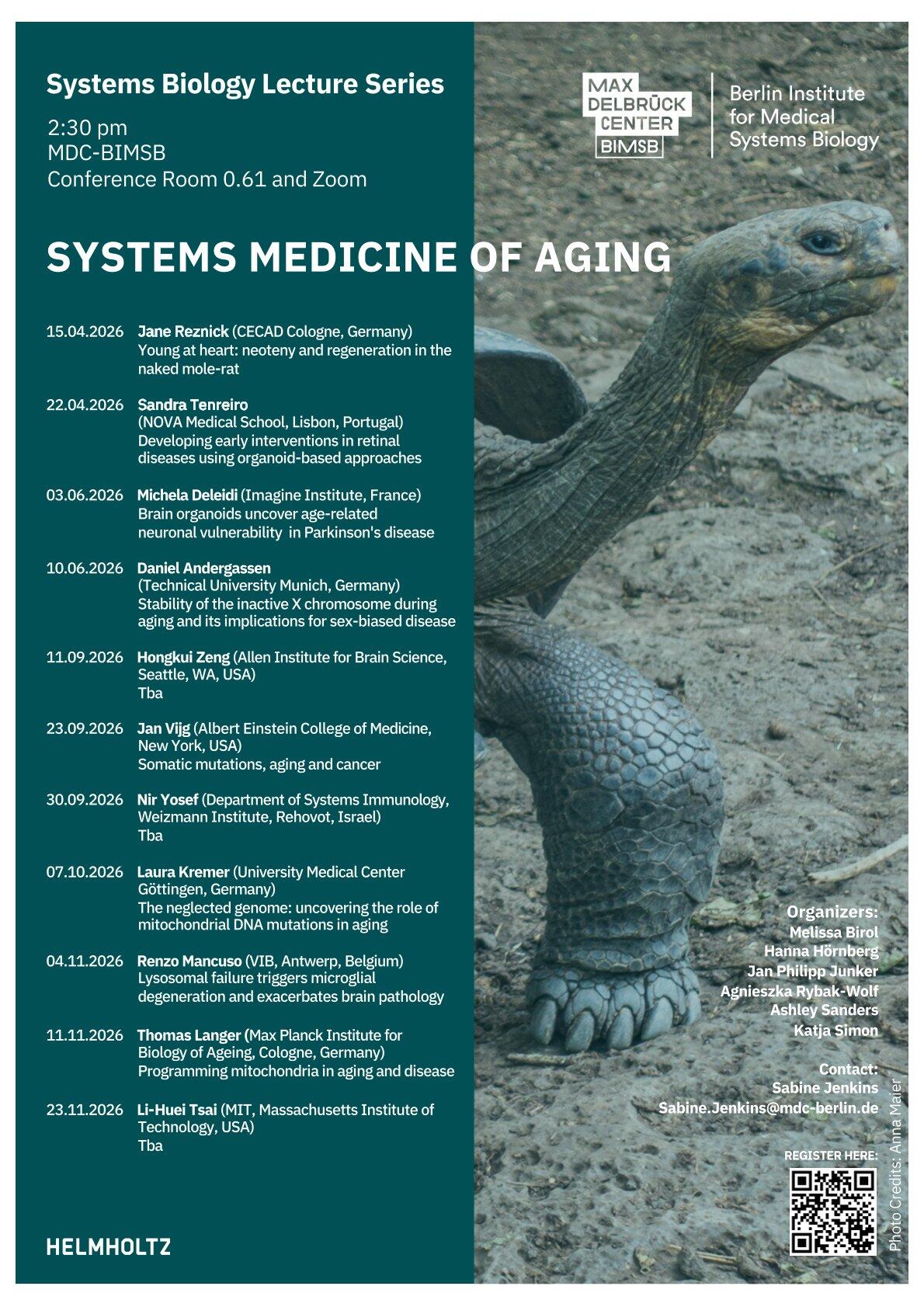
System Biology Lecture Series - Jan Vijg: Somatic mutations, aging and cancer
Abstract: Somatic mutations, varying from base substitutions to large chromosomal changes, result from errors during repair or replication of a damaged DNA template. Such errors are inherent to the molecular machinery that transfers information from genome to phenome. Indeed, maintenance of sequence integrity of the somatic genome far beyond the age of first reproduction has no evolutionary advantages and would have fitness costs. Mutations are irreversible except through cell or organismal death. Mutations in the germline are the ultimate source of the great diversity of life forms on our planet. However, in multicellular organisms, mutations also occur in somatic cells, where they mostly have adverse effects. Indeed, somatic mutations cause cancer in mammals and have been causally implicated in other features of the aging process, such as functional decline and degenerative diseases other than cancer. Somatic mutations have only recently become amenable to quantitative analysis through the development of single-cell and single-molecule sequencing assays. Using these assays, we and others demonstrated that somatic mutations accumulate with age in a tissue-specific manner from several hundred mutations per cellular genome in newborns to several thousands in tissues of the elderly. Here, I will present data on the age-related mutation burden in germ cells, stem cells and somatic cells and the possible functional impact of an increased mutation burden in aging and cancer.
Biography: Jan Vijg is Professor and Chairman of the Department of Genetics at the Albert Einstein College of Medicine in New York since July 2008. He received his PhD from the University of Leiden, The Netherlands, in 1987, and moved to the US in 1993. He was an Associate Professor at Harvard Medical School from 1993 to 1999, a Professor at the University of Texas Health Science Center in San Antonio from 1999 to 2005, and a Professor at the Buck Institute for Research on Aging in Novato, CA, from 2005 to 2008.
With his research team he was the first to develop transgenic mouse models for studying somatic mutations in different organs and tissues (in 1989), one of which (MutaMouse) became the industry standard in genetic toxicology testing. His lab used these mouse models to demonstrate an age-related increase in somatic mutations for most tissues, as well as tissue-specificities in the types of mutations accumulating, from base substitutions to large genome rearrangements. Since 2007 he has developed single-cell and single-molecule methods for studying somatic mutations and epimutations in relation to aging and disease. Using these methods, he demonstrated that, also in humans, somatic mutations accumulate with age in a tissue-specific manner. Dr. Vijg’s research has been continuously funded by the US National Institutes of Health since 1994. He has published over 400 scientific articles and three books.
Venue
MDC-BIMSB
Hannoversche Str. 28
Room 0.61 & Online
10115 Berlin
Germany
Time
Organizers
Host: AS (Anna Sonsala)