The smell of success
Imagine the following scenario: A head of state enters a room and emits a scent that prevents potential rivals from even considering challenging them. What’s more, they remain calm and focused on their tasks. It may sound like a dystopian fantasy, but in naked mole-rat societies — it’s a way of life.

Mohammed Khallaf (left) and Gary Lewin (right) in front of the building housing the naked mole-rat room.
An international team led by Dr. Gary Lewin, Group Leader of the Molecular Physiology of Somatosensory Perception lab at the Max Delbrück Center in Berlin, has discovered that the queens of naked mole-rat colonies release a volatile compound called isopropyl myristate, which induces temporary infertility in all other females in the colony.
“It works even when the queen is absent and the animals are exposed only to the scent,” says Dr. Mohammed Khallaf from the Lewin lab and first author of the study. The research, which includes groups from Berlin, Frankfurt, Jena, Munich, and Paris, as well as collaborators in Egypt, South Africa, Tanzania, the Czech Republic, and the United States, was published in “Nature.”
Odorless to humans, not to naked mole-rats
For roughly 25 years, Lewin has studied the biology of naked mole-rats, a mammal native to Africa that is of considerable medical interest. The rodents — about 450 of which currently live at the Max Delbrück Center in tunnel systems modeled after their natural habitat — have exceptionally long lifespans, rarely develop cancer, and experience little pain. They are also among the very few eusocial mammal species that live in highly organized colonies, similar to those of bees or ants. A single breeding queen sits at the top of the hierarchy, while numerous infertile workers cooperate to gather food, raise young, and perform other tasks that benefit the colony.

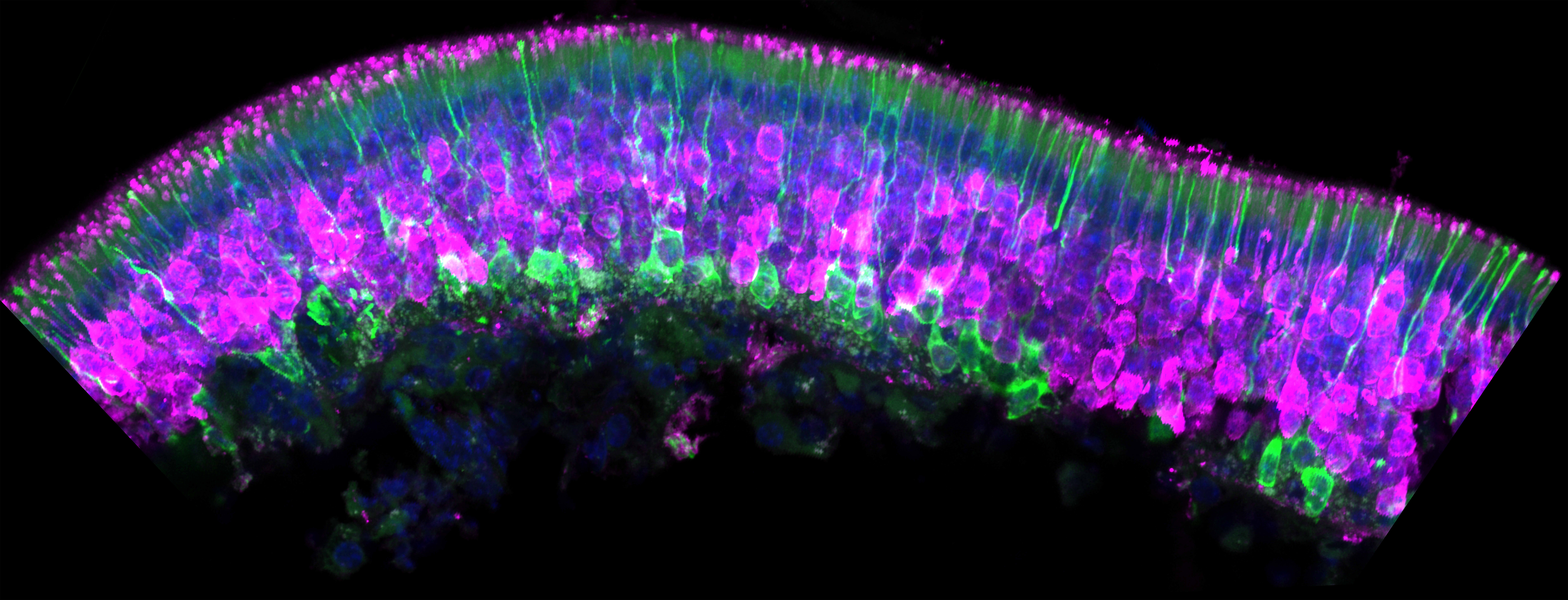
The immunofluorescence image of the naked mole-rat olfactory epithelium shows mature olfactory sensory neurons (magenta), immature olfactory sensory neurons (green), and cell nuclei (blue).
“For this study, we wanted to understand the biological mechanisms that allow the queen to maintain her exclusive reproductive status,” says Lewin. “We suspected that scent cues might play an important role, as they do in insects, particularly because we had already found that naked mole-rats use smell to distinguish members of their own colony from those from foreign colonies.”
The researchers used mass spectrometry to characterize volatile compounds emitted exclusively by queens. They identified a familiar chemical: isopropyl myristate, which is commonly used in cosmetics as a solvent and moisturizing agent. It is odorless to humans, but turns out to be a very powerful compound in naked mole-rats.
“Using electrophysiological techniques and functional ultrasound imaging, which measures blood flow and thus activity in specific brain regions, we showed that their olfactory receptors detect the compound and that the resulting signals are processed in the brain’s olfactory centers,” explains Khallaf. “Higher-ranking animals also avoid the scent when given the opportunity, likely because it reminds them of the queen’s dominance.”
The queen odor alters hormone levels
When a naked mole-rat queen dies or is removed from the colony, fierce fights and new mating behaviors emerge within days. Once the first female becomes pregnant, she assumes the role of queen and stability returns. “In our experiments, however, we found that the queen’s physical presence is not essential for maintaining harmony in the colony,” says Lewin. “Simply spraying isopropyl myristate into the colony each day was enough.” However, without the queen’s odor, conflicts quickly resumed.
The compound had similar effects in pairs of animals. “If you place a female and a male from the same colony together in a cage, they become sexually active after a few days,” says Khallaf. “That does not happen if they are exposed on a daily basis to bedding carrying the queen’s scent. Remarkably, sexual interest also did not emerge when we applied isopropyl myristate directly to their cage each day.”
A pregnant naked mole-rat queen resting in the colony.
Further experiments revealed that isopropyl myristate increases levels of prolactin, a hormone that reduces fertility in mammals. At the same time, it keeps levels of the fertility-promoting hormone progesterone low. “Together, these findings explain why naked mole-rats exposed to the queen’s scent do not reproduce,” explains Lewin.
Different species, similar strategies
The researchers also showed that queens produce isopropyl myristate only during pregnancy. “When a queen can no longer reproduce, progesterone levels rise in the other animals and prolactin levels fall,” says Lewin. “At that point, succession struggles within the colony begin again.”
“The idea that a single scent can maintain peace and prevent violence may sound like science fiction,” says Khallaf. “In the world of naked mole-rats, it is reality.” The team was surprised that such a complex social system appears to be regulated by a single chemical signal rather than a cocktail of pheromones, which is typically the case in insects, he adds. “Apparently, evolution likes to fall back on tried-and-true — and sometimes simplified — strategies, even across radically different species.”
Text: Anke Brodmerkel
Further information

Literature
Mohammed Khallaf, Daniel Hart, Wenhan Luo, et al. (2026): “A queen odour mediates reproductive suppression in a eusocial mammal.” Nature, DOI: 10.1038/s41586-026 – 10772‑5
Photos and videos for download
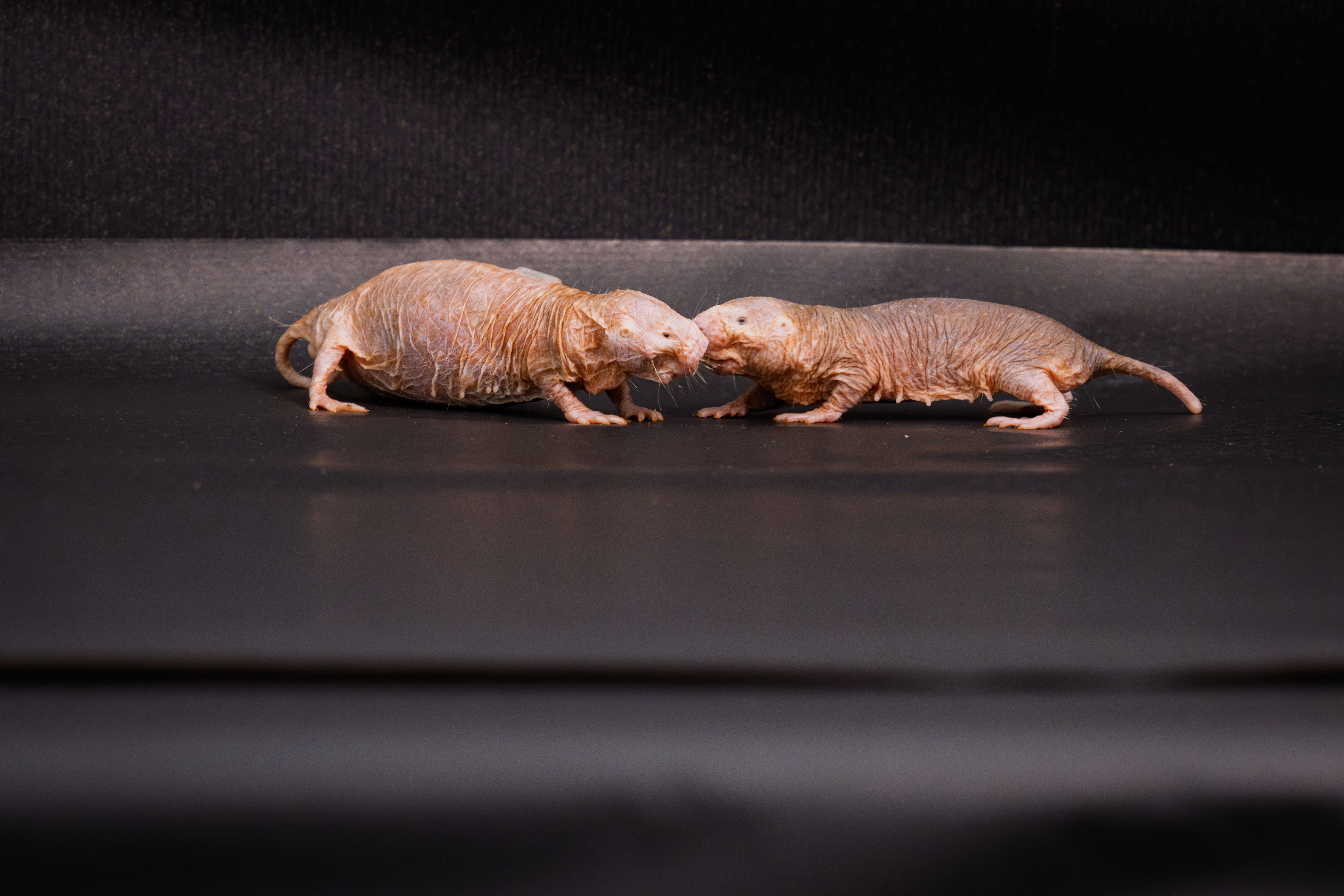
A pregnant naked mole-rat queen (left) and worker (right) sniff each other.
Credit: Felix Petermann, Max Delbrück Center
The immunofluorescence image of the naked mole-rat olfactory epithelium shows mature olfactory sensory neurons (magenta), immature olfactory sensory neurons (green), and cell nuclei (blue).
Credit: Mohammed Khallaf, Lewin Lab, Max Delbrück Center
Mohammed Khallaf (left) and Gary Lewin (right) in front of the building housing the naked mole-rat room.
Credit: Felix Petermann, Max Delbrück Center
A pregnant naked mole-rat queen resting in the colony.
Video credit: Anika Mühlenberg, Max Delbrück Center
Additional photos as well as extensive b‑roll footage for videos are available upon request.
Contacts
Dr. Gary Lewin
Group Leader
“Molecular Physiology of Somatosensory Perception” Lab
Max Delbrück Center
glewin@mdc-berlin.de
Jana Schlütter
Communication and Marketing
Max Delbrück Center
+49 30 9406 – 2121
Jana.Schluetter@mdc-berlin.de or presse@mdc-berlin.de
- Max Delbrück Center
-
The Max Delbrück Center for Molecular Medicine in the Helmholtz Association lays the foundation for the medicine of tomorrow through our discoveries of today. At locations in Berlin-Buch, Berlin-Mitte, Heidelberg, and Mannheim, interdisciplinary teams investigate the complexity of disease at the systems level – from molecules and cells to organs and entire organisms. Together with academic, clinical, and industry partners, and as part of global networks, we turn biological insights into innovations for early detection, personalized therapies, and disease prevention. Founded in 1992, the Max Delbrück Center is home to a vibrant, international research community of around 1,800 people from over 70 countries. We are 90 percent funded by the German federal government and 10 percent by the state of Berlin.