
Distinct metabolic signature found in HFpEF
What exactly happens in the hearts of patients with heart failure with preserved ejection fraction (HFpEF) – and how can this knowledge be used to develop new therapies?
A research team led by Dr. Gabriele Schiattarella from the Deutsches Herzzentrum der Charité and a guest researcher at the Max Delbrück Center now has an answer: The heart muscle of patients with HFpEF and obesity shows a very distinct metabolic pattern – a kind of “metabolic fingerprint.” This fingerprint, the researchers found, is distinct from people with obesity but who do not have symptoms of cardiometabolic diseases. The study was published in “Cardiovascular Research.”
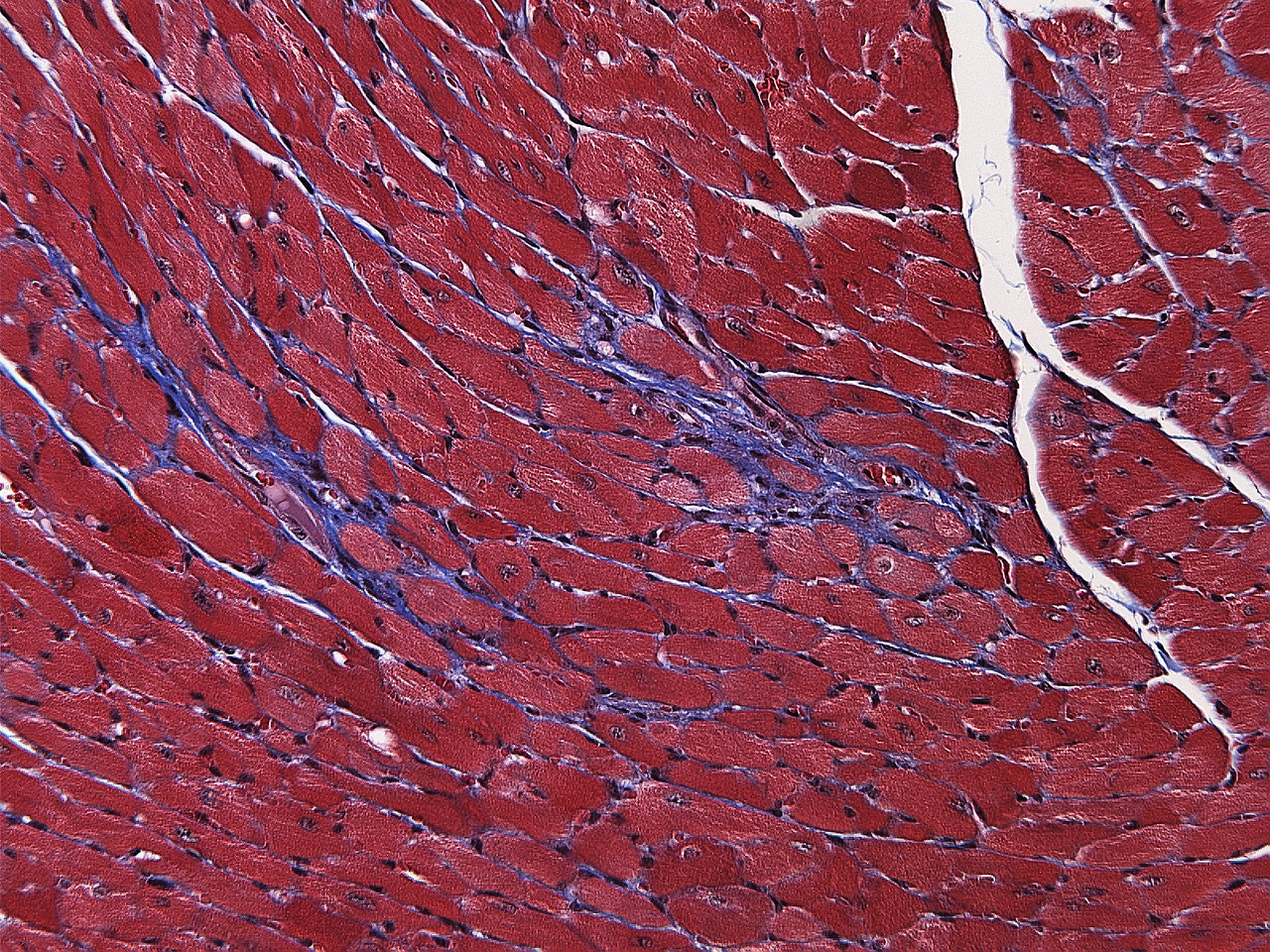
Cardiac tissue from a mouse
To uncover the fingerprint, the researchers – in collaboration with Drs. Stefan Kempa and Philipp Mertins, Group Leaders of the Proteomics and Metabolomics and Proteomics Technology Platforms respectively – analyzed biopsied tissue from 19 patients with HFpEF who were severely overweight or obese. They then compared the results to heart tissue from four people who were also severely overweight or obese but did not suffer from heart failure. They examined various types of molecules – including lipids, proteins and metabolic products. This approach (also known as multiomics) makes it possible to obtain a particularly comprehensive picture of the dynamic processes that take place in heart tissue.
The results showed that although fat metabolism in the hearts of obese patients with HFpEF remained largely normal, glucose metabolism was disrupted. At the same time, certain metabolic products accumulated, and they found signs indicating that the heart lacked energy. These changes were closely linked to the extent of structural changes in the heart and the severity of the disease.
HFpEF and obesity distinct diseases
The study highlights that these metabolic changes are not simply a consequence of obesity. HFpEF – incidentally, the most common form of heart failure – is, in fact, a distinct condition with specific molecular characteristics. This brings new therapeutic and preventive approaches into focus – particularly treatments that specifically target the heart’s metabolism.
“Our findings highlight metabolic pathways as potential targets for therapy, including improving cardiac glucose metabolism and reducing harmful by-products, pointing toward more targeted treatments and early prevention strategies in HFpEF,” explains Schiattarella, senior author of the paper.
Gabriele Schiattarella is a W2 Professor of Cardiometabolic Diseases at the DHZC and conducts research at the Friede Springer Cardiovascular Prevention Centre. His professorship is supported by the German Heart Center Foundation. At the Max Rubner Center at Charité and the Max Delbrück Center, the scientist and his team are investigating the role of metabolic changes in the development of various forms of heart failure and other diseases. He is deputy spokesperson for the Collaborative Research Centre SFB 1470, which aims to improve treatment of HFpEF.
Text: Julika Witte, DHZC
Further information

Literature
Federico Capone, Karl-Philipp Rommel, Martin Forbes, et al. (2026). “Integrated left ventricular multi-omics landscape of human cardiometabolic HFpEF.” Cardiovascular Research, DOI: 10.1093/cvr/cvag084
Contact
Julika Witte
Communications and Marketing
Deutsches Herzzentrum der Charité
T +49 30 4593 – 2093
M +49 173 5749964
julika.witte@dhzc-charite.de
Gunjan Sinha
Editor, Communications
Max Delbrück Center
+49 30 9406 – 2118
Gunjan.Sinha@mdc-berlin.de or presse@mdc-berlin.de
- The Max Delbrück Center
The Max Delbrück Center for Molecular Medicine in the Helmholtz Association aims to transform tomorrow’s medicine through our discoveries of today. At locations in Berlin-Buch, Berlin-Mitte, Heidelberg and Mannheim, our researchers harness interdisciplinary collaboration to decipher the complexities of disease at the systems level – from molecules and cells to organs and the entire organism. Through academic, clinical, and industry partnerships, as well as global networks, we strive to translate biological discoveries into applications that enable the early detection of deviations from health, personalize treatment, and ultimately prevent disease. First founded in 1992, the Max Delbrück Center today inspires and nurtures a diverse talent pool of 1,800 people from over 70 countries. We are 90 percent funded by the German federal government and 10 percent by the state of Berlin.


