How immune cells spur repair of the heart
When the human heart is damaged from a heart attack, stiff scar tissue eventually forms around the affected areas. This weakens the heart’s pumping ability and increases the risk of heart failure and arrhythmias. Zebrafish, by contrast, can regenerate their hearts completely. Researchers led by Janita Mintcheva, a doctoral student in the Quantitative Developmental Biology lab of Dr. Jan Philipp Junker at the Max Delbrück Center, now show in “Nature Communications” that the process depends on a finely tuned inflammatory response.
Using an approach that can analyze nucleic acids in single cells, the team found that immune cells called macrophages are among the earliest responders to injury – they rapidly activate inflammatory programs that help kickstart regeneration. However, the trigger is not just inflammation itself, but its timing and strength that sets the stage for further healing.
“It had previously been shown that perturbing the early response to injury disturbs regeneration,” Mintcheva explains. “This suggested that the early response is integral to setting the tone for later regeneration. But it had not been clear exactly what happens during this early stage.”
Tracking new gene activity in single cells
To capture these early events, the researchers used a method called in vivo single-cell RNA metabolic labeling. It marks newly produced RNA inside individual cells, enabling scientists to identify gene activity in response to injury.
The team analyzed thousands of cells from zebrafish hearts within the first six hours of injury. They found that macrophages – and possibly neutrophils – were among the earliest responders, quickly switching into a pro-inflammatory state.
When the researchers dampened this response specifically in macrophages, blood vessels grew faster and more heart muscle cells entered into a proliferative phase — both processes required for regeneration.
“This was totally unexpected,” says Mintcheva. “Previous studies had suggested that globally modulating inflammation in zebrafish heart tissue, either intensifying or dampening it, impairs regeneration. Here we show that tamping down the inflammatory response specifically of macrophages helps to promote regeneration, pointing to these cells as key players in the process.”
Fine-tuning inflammation may enhance heart repair
The findings challenge a simple view of inflammation as either helpful or harmful. Instead, they point to a more nuanced role: too much or too little inflammation can impair regeneration, while precisely tuned responses can enhance it.
“It was surprising that heart regeneration, which is already efficient in zebrafish, can be improved even further by tweaking inflammatory signaling,” says Junker, senior author of the paper. “By targeting specific cell types, we may be able to steer regeneration in a beneficial direction.” The Junker lab has spent many years studying how zebrafish can regenerate theirorgans, and trying to understand what differentiates them from human organs, which have a limited capacity to repair themselves.
“It would be interesting to test whether adjusting immune responses in a controlled, cell-specific way could improve healing after heart attacks in mammals too,” adds Mintcheva.”
Text: Gunjan Sinha
Further information
Literature
Janita Mintcheva, Tzu-Lun Tseng, Pinelopi Goumenaki, et al. (2026): “In vivo single-cell RNA metabolic labeling resolves early transcriptional responders in the regenerating zebrafish heart.” Nature Communications, DOI: 10.1038/s41467-026 – 72781‑2
Image for download
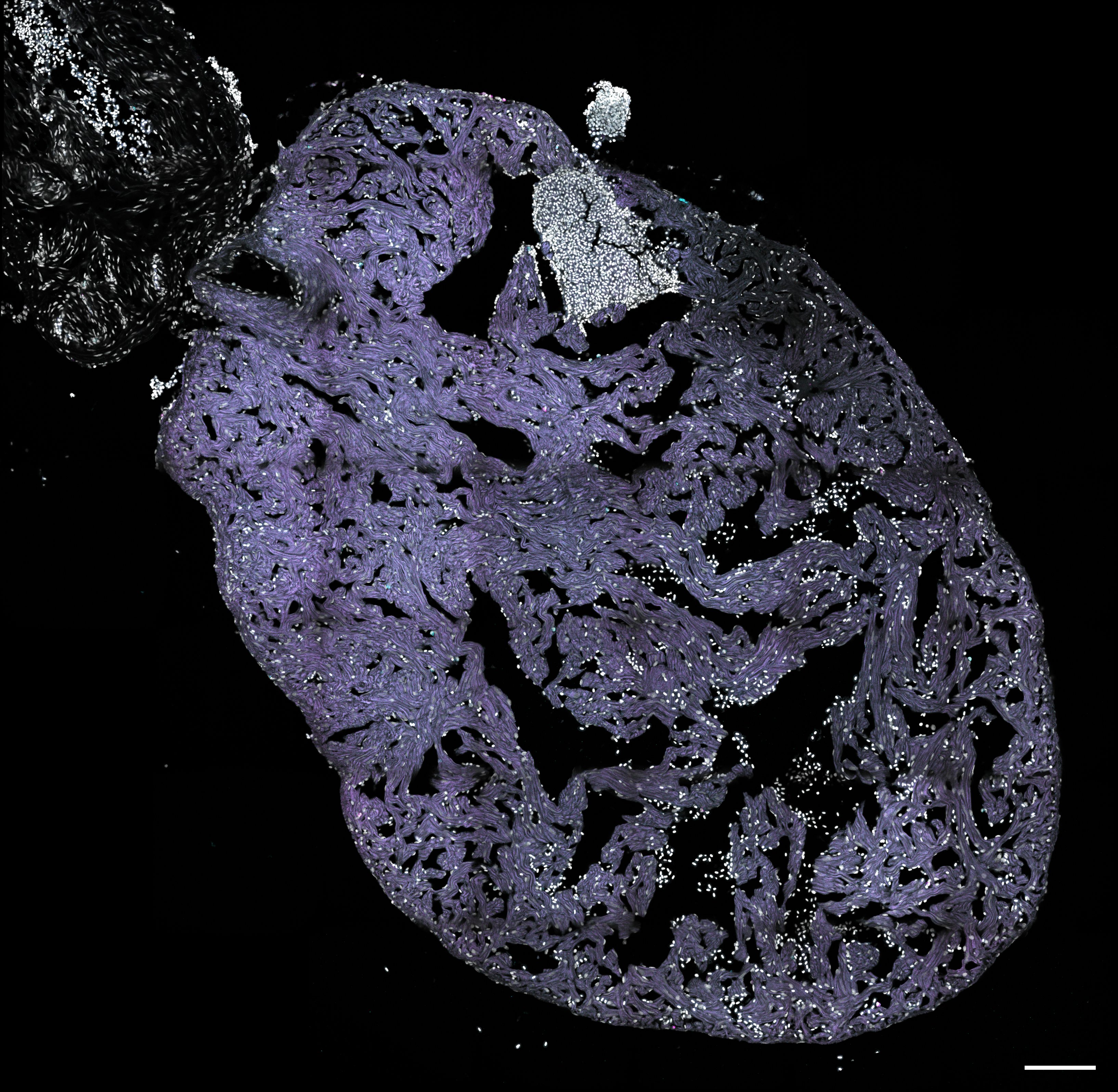
A zebrafish heart 6h after cryoinjury, visualized with confocal microscopy.
Credit: Janita Mintcheva, Max Delbrück Center
Contacts
Dr. Jan Philipp Junker
Group Leader
Quantitative Developmental Biology lab
Max Delbrück Center
JanPhilipp.Junker@mdc-berlin.de
Gunjan Sinha
Editor, Communications
Max Delbrück Center
+49 30 9406 – 2118
Gunjan.Sinha@mdc-berlin.de or presse@mdc-berlin.de
- Max Delbrück Center
The Max Delbrück Center for Molecular Medicine in the Helmholtz Association aims to transform tomorrow’s medicine through our discoveries of today. At locations in Berlin-Buch, Berlin-Mitte, Heidelberg and Mannheim, our researchers harness interdisciplinary collaboration to decipher the complexities of disease at the systems level – from molecules and cells to organs and the entire organism. Through academic, clinical, and industry partnerships, as well as global networks, we strive to translate biological discoveries into applications that enable the early detection of deviations from health, personalize treatment, and ultimately prevent disease. First founded in 1992, the Max Delbrück Center today inspires and nurtures a diverse talent pool of 1,800 people from over 70 countries. We are 90 percent funded by the German federal government and 10 percent by the state of Berlin.