Heart failure caused by an overactive protein
RBM20 cardiomyopathy is a rare and highly aggressive inherited form of heart disease in which the heart muscle enlarges and gradually loses the ability to pump blood effectively. Researchers at the Heidelberg based Helmholtz Institute for Translational AngioCardioScience (HI-TAC) — an external branch of the Max Delbrück Center located at Heidelberg University campus in Mannheim and Heidelberg, report in “Nature Cardiovascular Research” that the disease is not directly caused by mutations in the RBM20 gene. But rather, a defective gene leads to overactivation of the signaling protein CAMK2D.
The protein helps regulate calcium balance in heart muscle cells and thereby influences the heart’s pumping mechanism. In mouse models, overactive CAMK2D caused severe heart failure. When the researchers switched off the protein, heart function remained largely intact despite a RBM20 gene defect.
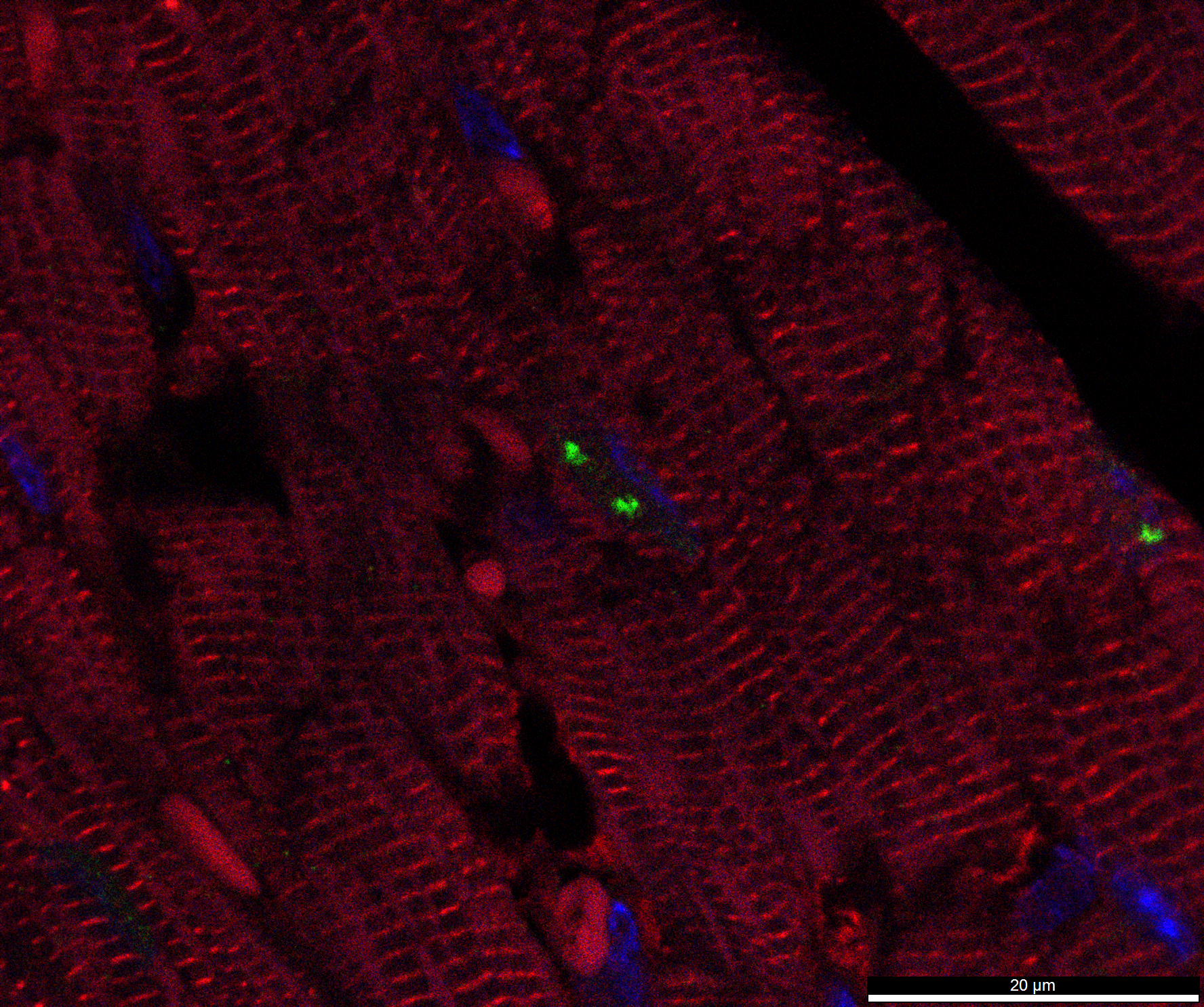
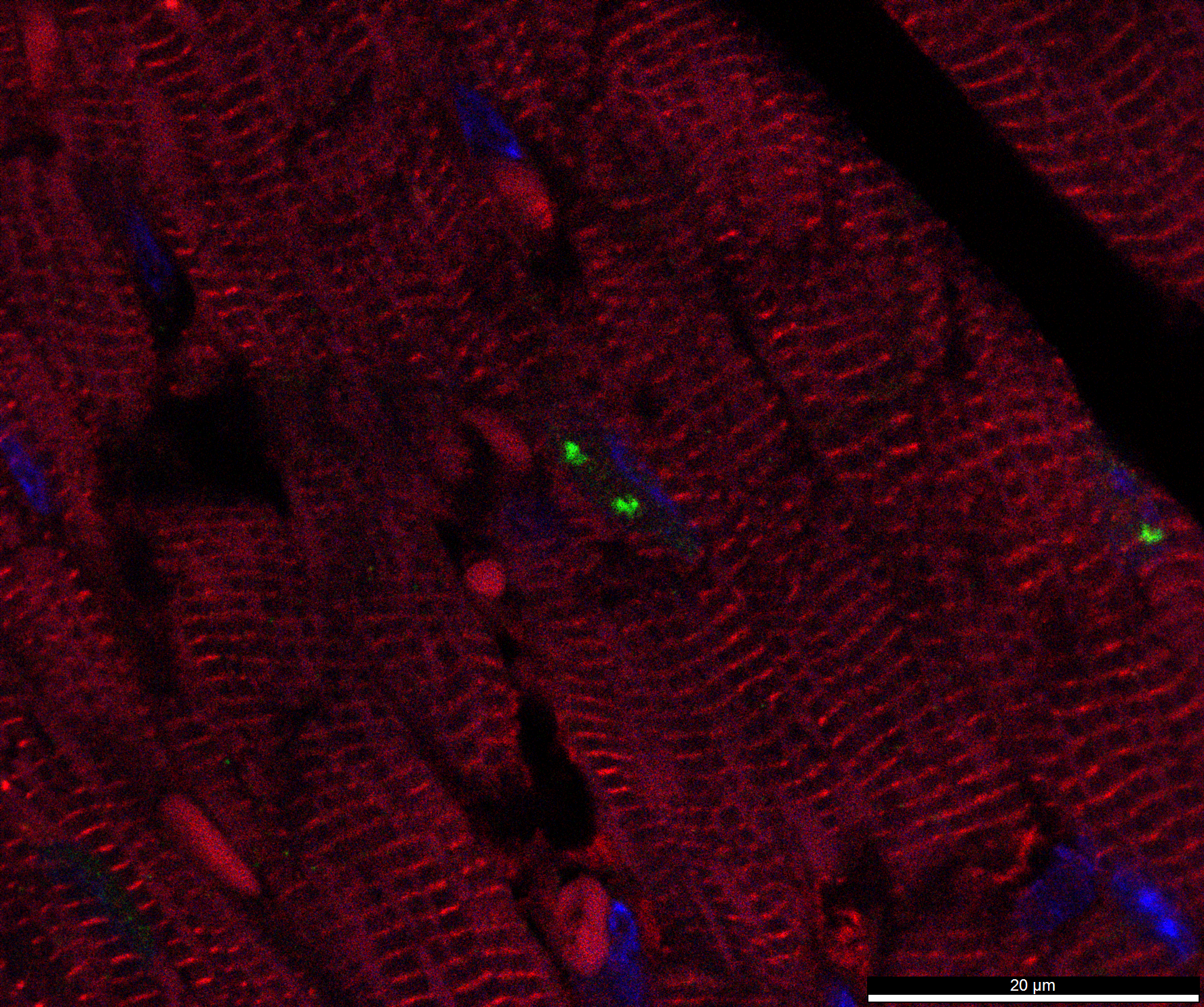
Microscopic image of heart muscle tissue in which RBM20 is stained green, the cell nuclei blue and sarcomeres, the smallest contractile units of the muscle fibers, red.
“Our study demonstrates that it is not the RBM20 variant per se, but the excessive activity of CAMK2D that drives disease pathogenesis,” says first author Dr. Maarten van den Hoogenhof, of the Heidelberg Faculty of Medicine, Junior Group Leader at the Institute for Experimental Cardiology at Heidelberg University Hospital and at HI-TAC.
A potential therapeutic approach
The findings point to a potential therapeutic strategy based on specifically blocking CAMK2D. Drugs targeting the protein are already being developed for other types of heart disease. “At present, all patients with cardiomyopathies are treated with the same medications,” says senior author Dr. Johannes Backs, Professor of Experimental Cardiology at the Heidelberg Faculty of Medicine, Director of the Institute for Experimental Cardiology at Heidelberg University Hospital and Interim Director of HI-TAC.
“However, our research suggests that certain genetic variations could influence how well a drug works,” Backs explains. “If this is confirmed, it would be a major step toward precision medicine. In the future, all cardiomyopathy patients should then undergo genetic testing so treatments can be tailored to the individual.”
The work was conducted within Collaborative Research Center 1550 “Molecular Circuits of Heart Disease,” coordinated by the Heidelberg Faculty of Medicine, with contributions from the German Centre for Cardiovascular Research (DZHK) and HI-TAC. The second funding period of CRC 1550 has recently been approved by the German Research Foundation (DFG).
Further information
Literature
Martin van den Hoogenhof, Javier Duran, Thiago Britto-Borges, et al. (2026): „CAMK2D causes heart failure in mice with RBM20 cardiomyopathy“. Nature Cardiovascular Research, DOI: 10.1038/s44161-026 – 00818‑2
Photo for download
© The van den Hoogenhof lab, HI-TAC
Contacts
Maarten van den Hoogenhof
Group Leader, HI-TAC
Heidelberg Faculty of Medicine
maarten.vandenhoogenhof@med.uni-heidelberg.de
Jana Schlütter
Deputy Head
Communications and Marketing
Max Delbrück Center
+49 30 9406 – 2118
Jana.Schluetter@mdc-berlin.de or presse@mdc-berlin.de
- Max Delbrück Center
-
The Max Delbrück Center for Molecular Medicine in the Helmholtz Association lays the foundation for the medicine of tomorrow through our discoveries of today. At locations in Berlin-Buch, Berlin-Mitte, Heidelberg, and Mannheim, interdisciplinary teams investigate the complexity of disease at the systems level – from molecules and cells to organs and entire organisms. Together with academic, clinical, and industry partners, and as part of global networks, we turn biological insights into innovations for early detection, personalized therapies, and disease prevention. Founded in 1992, the Max Delbrück Center is home to a vibrant, international research community of around 1,800 people from over 70 countries. We are 90 percent funded by the German federal government and 10 percent by the state of Berlin.