How cancer cells lose their most dangerous DNA
Cells from rapidly growing, highly metastatic tumors often contain numerous rings of extrachromosomal DNA (ecDNA). This circular DNA frequently carries oncogenes — genes that promote cancer. Researchers have long sought vulnerabilities in these DNA rings in an effort to stop their harmful activity.
An international team led by Dr. Anton Henssen, Group Leader of the Genomic Instability in Pediatric Tumors lab at the Experimental and Clinical Research Center, a joint institution of Charité – Universitätsmedizin Berlin and the Max Delbrück Center, has now identified a potential target. As the researchers report in “Nature Genetics,” the DNA rings lose their activity when they become trapped outside the cell nucleus in micronuclei — a process that also occurs naturally in cancer cells. Consequently, active compounds that drive ecDNA into micronuclei may help treat some metastatic cancers.
In addition to Henssen, the study’s senior authors are Dr. Howard Chang and Dr. Paul Mischel of Stanford University in California. Since December 2024, Chang has served as Chief Scientific Officer at Amgen, one of the world’s leading biotechnology companies. Mischel leads the eDyNAmiC team within the international Cancer Grand Challenges initiative, which seeks to better understand the key role of circular DNA in cancer. The current study was conducted as part of that project.
Hitchhiking during cell division
When a cell divides, its chromosomes are normally distributed evenly between two daughter cells. ecDNA behaves differently. “These DNA rings lack the structures needed for orderly transport,” Henssen explains. “Instead, they attach themselves to chromosomes and essentially hitchhike into the new cells.” Some rings succeed, while others do not. “The less successful ones become trapped in micronuclei,” he says.

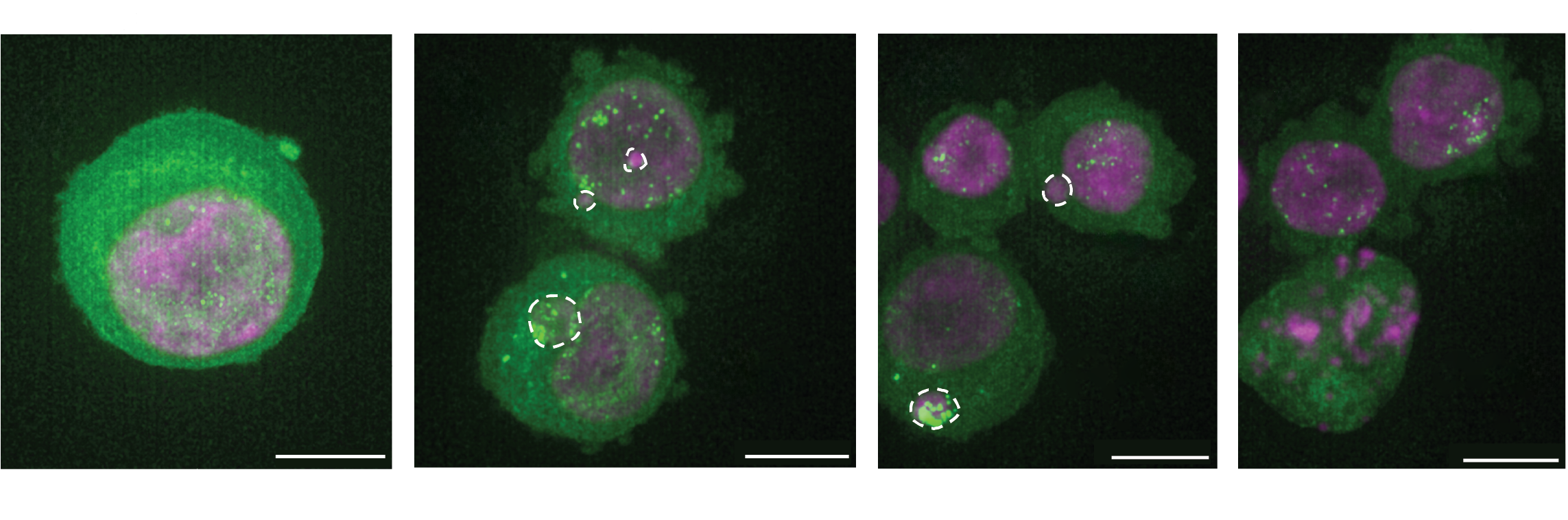
This sequence of images shows a cell containing micronuclei, which is undergoing cell death. Chromatin is stained in pink, and ring-shaped DNA in florescent green. The white dotted lines mark regions with micronuclei.
Scientists have documented the existence of micronuclei, which are visible under a light microscope and are commonly found in cancer cells, for many years. Using a laser-assisted method developed with Dr. Ana Pombo at the Max Delbrück Center, Henssen’s team sequenced the genetic material of individual micronuclei. “We found that micronuclei are primarily filled with ecDNA,” says Robin Xu in Henssen’s lab and one of the study’s three first authors. “This means we can estimate the amount of ecDNA in cancer cells simply by observing visible micronuclei.”
The researchers also discovered that the structure of the DNA rings changes once they are inside micronuclei. “As a result, the cell can no longer read the genes carried on these rings or translate them into proteins,” adds Lotte Brückner, who shares first authorship with Xu.
“Cancer cells containing many micronuclei therefore have a significant survival disadvantage, making this finding important for both the diagnosis and prognosis of cancer.”
Preventing DNA rings from hitchhiking
Using a well-characterized cohort of several hundred patients with neuroblastoma, Henssen and his colleagues showed that survival was strongly associated with the presence of micronuclei. “The more micronuclei containing large amounts of circular DNA we found in tumor cells, the more successful the patients’ treatment was,” Henssen says.
The researchers are now investigating ways to prevent DNA rings from hitchhiking into new nuclei during cell division. Their goal is to ensure that as many rings as possible end up trapped inside micronuclei, the cellular “prisons,” where they can no longer drive cancer growth.
“We already know of drugs that block the proteins ecDNA uses to attach itself to chromosomes,” Henssen says. Econic Bioscience, a company Henssen founded in London in 2022 along with the former founders of CRISPR therapeutics Dr. Rodger Novak and Shaun Foy, is actively searching for additional active ingredients that transport the destructive DNA rings into the micronuclei as quickly as possible — and securely seal them there.
Text: Anke Brodmerkel
The study was funded by Cancer Grand Challenges and the German Research Foundation (DFG) Collaborative Research Center (CRC) 1588, “Deciphering Evolutionary Mechanisms in Neuroblastoma.” Anton Henssen is the spokesperson for CRC 1588.
Further information
Henssen lab (Max Delbrück Center)
Henssen lab (Charité)
Cancer Grand Challenges
eDyNAmiC
Literature
Lotte Brückner, Robin Xu, Jun Tang, et al. (2026): “Micronuclear ecDNA constrains tumor cell fitness and is associated with favorable patient survival.” Nature Genetics, DOI: 10.1038/s41588-026 – 02782‑w
Image for download
This sequence of images shows a cell containing micronuclei, which is undergoing cell death. Chromatin is stained in pink, and ring-shaped DNA in florescent green. The white dotted lines mark regions with micronuclei.
© Aditi Gnanasekar, Stanford University
Contacts
Prof. Dr. Anton Henssen
Group Leader
Genomic Instability in Pediatric Tumors
Experimental and Clinical Research Center anton.henssen@charite.de
Anke Brodmerkel
Editor, Communications & Marketing
Max Delbrück Center
+49 1522 175 77 95 anke.brodmerkel@mdc-berlin.de or presse@mdc-berlin.de
- Max Delbrück Center
-
The Max Delbrück Center for Molecular Medicine in the Helmholtz Association lays the foundation for the medicine of tomorrow through our discoveries of today. At locations in Berlin-Buch, Berlin-Mitte, Heidelberg, and Mannheim, interdisciplinary teams investigate the complexity of disease at the systems level – from molecules and cells to organs and entire organisms. Together with academic, clinical, and industry partners, and as part of global networks, we turn biological insights into innovations for early detection, personalized therapies, and disease prevention. Founded in 1992, the Max Delbrück Center is home to a vibrant, international research community of around 1,800 people from over 70 countries. We are 90 percent funded by the German federal government and 10 percent by the state of Berlin.