
Bioengineering the future of medicine
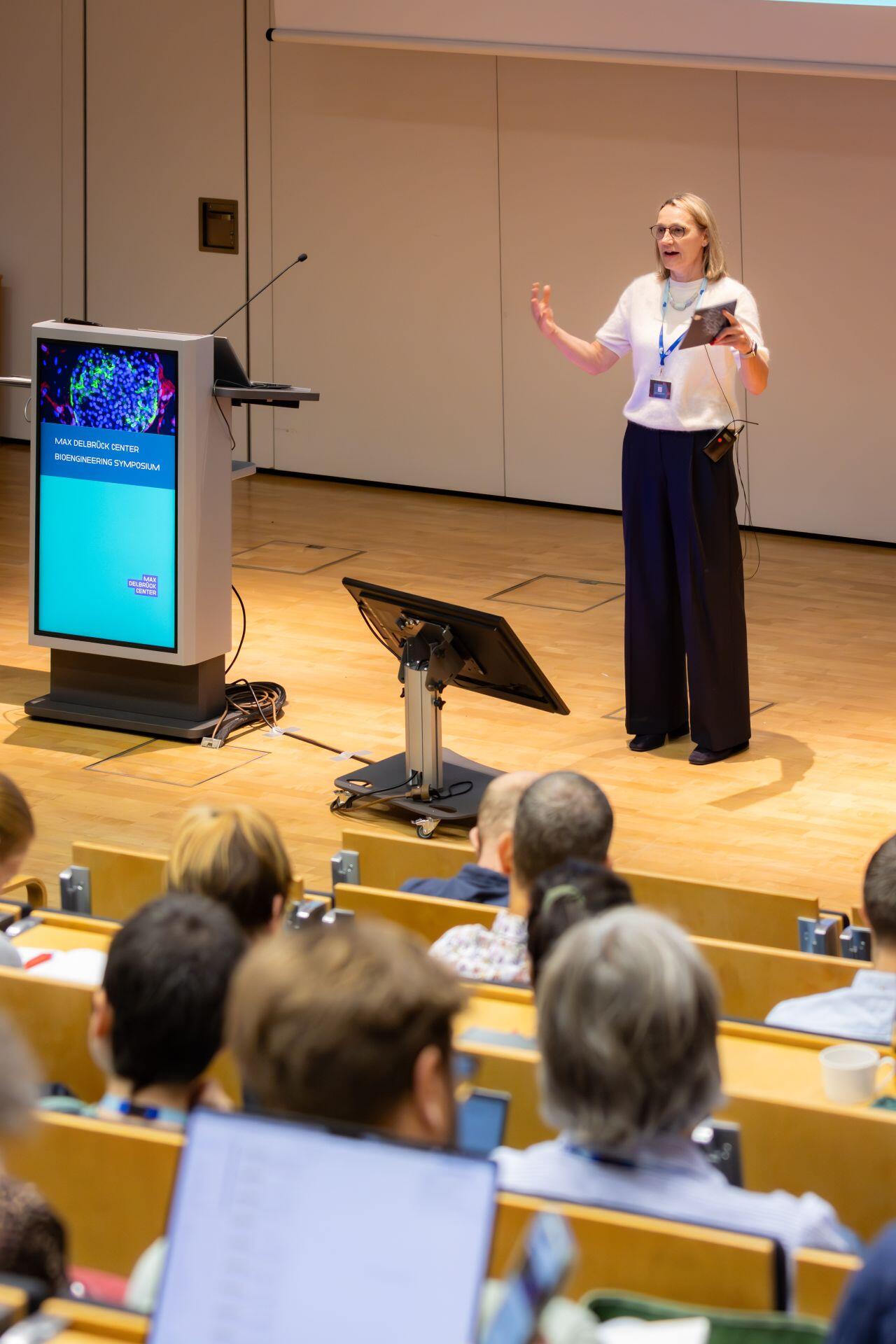
Maike Sander, Scientific Director of the Max Delbrück Center, welcomed participants and officially opened the Symposium.
What once sounded like science fiction is becoming reality. Researchers can bioprint tissues, engineer organoids that reproduce key features of human organs, and redesign immune cells to recognize disease with increasing precision. Bioengineering is opening a new era in which living systems can be rationally designed, enabling discoveries that can be translated into more precise diagnostics, more predictive drug development, and new forms of regenerative and personalized therapy.
“The Max Delbrück Center has a long tradition of uncovering the biological mechanisms that drive health and disease. The next step is to harness that knowledge to engineer new solutions,” said Dr. Maike Sander, Scientific Director of the Max Delbrück Center and co-organizer of the symposium.
“Berlin already brings together world-class expertise in biology, engineering, medicine, and data science. By leveraging this collective strength and deepening collaboration across institutions, we can accelerate the translation of discoveries into real-world impact.”
Building more human models of disease

The poster session provided a relaxed setting for participants to exchange ideas and network while enjoying snacks and refreshments.
A central challenge in biomedical research is to create experimental systems that reflect human biology more faithfully than conventional cell cultures or animal models.
In his keynote address, Dr. Matthias Lütolf of the Institute of Human Biology and Roche in Basel described how researchers are engineering organoids that reproduce key properties of living tissues, including their physical environment, vascularization, and communication with other organs.
These systems could enable more accurate studies of disease, improve the prediction of drug responses, and support therapies tailored to individual patients. Lütolf’s work with microfluidic organ-on-chip technologies points toward dynamic, integrated models of human physiology.
From disease models to living therapies
Bioengineering is also expanding the boundaries of regenerative medicine. Keynote speaker Dr. Kelly Stevens of the University of Washington highlighted her innovative research on bioprinting vascularized liver tissue. Her vision is not only to recreate the architecture of an organ, but to generate living tissue that can survive, integrate, and function after transplantation.
Scientific and technical challenges remain, particularly in scaling tissues, establishing a reliable blood supply, and ensuring long-term function. Yet the direction is clear: bioengineering is moving from observing biology to constructing systems that may one day repair or replace damaged tissue.
The same shift is visible in cell-based therapies. Researchers are redesigning immune cells to recognize tumors more precisely and developing synthetic cells that could eventually detect disease signals and deliver treatment directly where it is needed.
One ambition, many disciplines
The symposium made clear that the future of medicine will not be driven by a single technology or discipline. Progress will depend on combining cell biology, materials science, engineering, medicine, data science, and AI.
This convergence matches the Max Delbrück Center’s strengths in fundamental biology, systems medicine, data science, and translation. By combining these capabilities with engineering expertise, clinical partnerships, and industry collaborations, the Max Delbrück Center aims to help shape an internationally connected bioengineering ecosystem rooted in Berlin.
Building a bioengineering hub with global reach
Biomedical engineering is one of three new funding initiatives of the Helmholtz Association and part of Germany’s High-Tech Agenda, reflecting the growing strategic importance of technologies that connect biological discovery with scalable medical innovation.

The organizers of the first Bioengineering Symposium (from left to right): Maike Sander, Christine-Maria Horejs, Karen Christman, and Milica Radisic.
Helmholtz has also approved €30.8 million for the Center for AI-Accelerated Molecular Innovations in Medicine, AI2M, at the Max Delbrück Center. As part of an emerging bioengineering hub on the Berlin-Buch campus, AI2M will bring together artificial intelligence, molecular research, engineering, and translational medicine.
The ambition extends beyond a single institution or location. By connecting researchers, clinicians, technology experts, and industry partners across Berlin and international networks, the hub can help move discoveries more efficiently toward clinical application.
For the Max Delbrück Center, this is both a scientific opportunity and a strategic responsibility: to turn advances in bioengineering into tangible benefits for patients.
Further information
- New Max Delbrück Center focus on bioengineering
- New Helmholtz research initiatives in 2026
- Helmholtz Biomedical Engineering Initiative
- News about Karen Christman
- News about Milica Radisic
- Op-ed by Maike Sander on innovation in medicine
- AI-Accelerated Molecular Innovations in Medicine (AI2M)


