
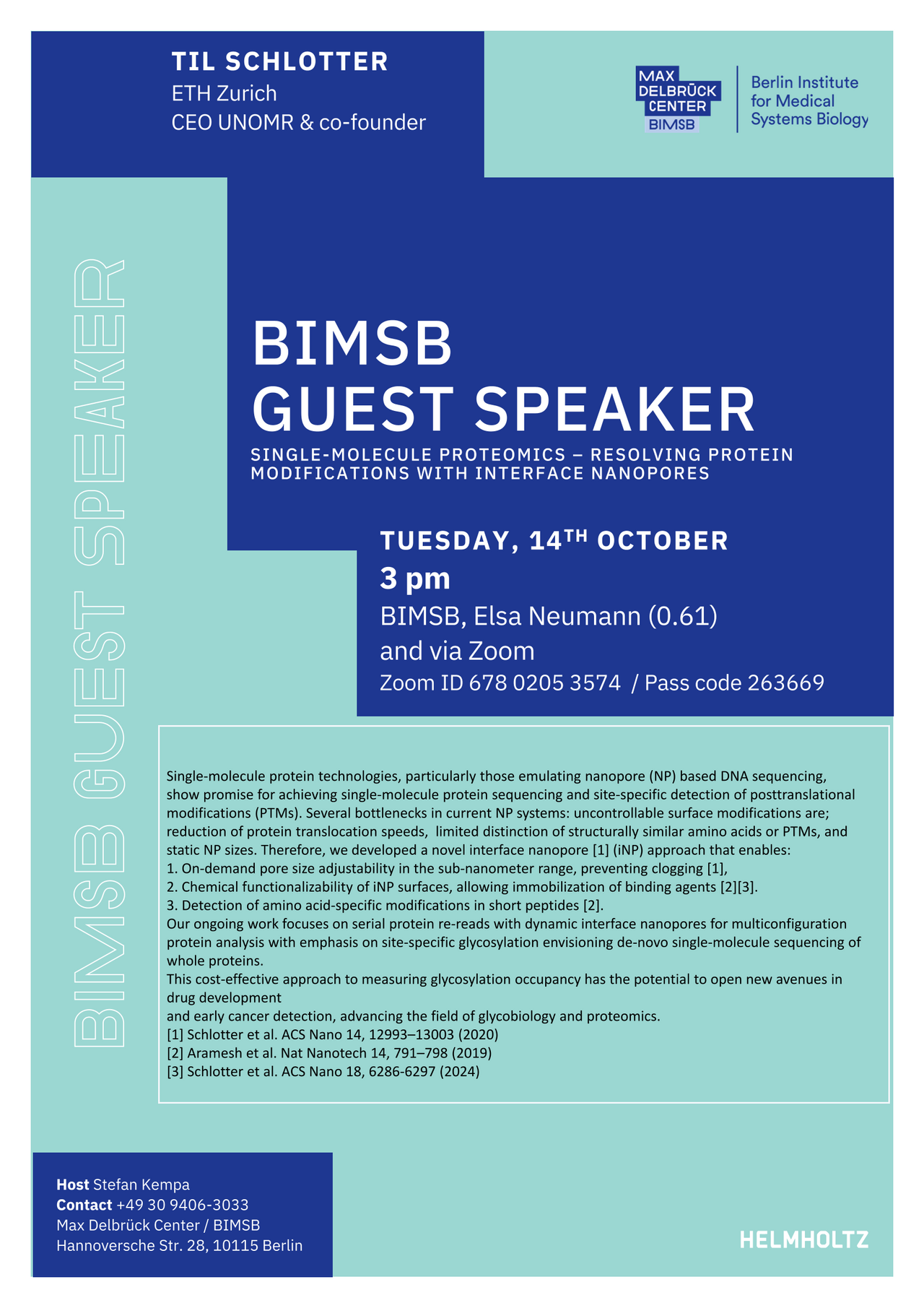
Til Schlotter: Single-Molecule Proteomics – Resolving Protein Modifications with Interface Nanopores
The advent of Next Generation Sequencing has transformed medicine, yet a genotype-phenotypegap
remains. Therefore, single-molecule protein sensors with enhanced sensitivity and selectivity are
essential. Single-molecule protein technologies, particularly those emulating nanopore (NP) based
DNA sequencing, show promise for achieving single-molecule protein sequencing and site-specific
detection of posttranslational modifications (PTMs).
Several bottlenecks have been identified in current NP systems: uncontrollable surface modifications,
reduction of protein translocation speeds, limited distinction of structurally similar amino acids or
PTMs, and static NP sizes. The issue of static nanopore sizes is especially problematic for glycosylation
occupancy analysis. Glycan conjugates exhibit a wide size range, from single nanometers to several
tens of nanometers. In contrast, typical nanopores have fixed diameters of only a few nanometers.
This size mismatch often results in pore clogging, significantly hampering the analysis of glycosylated
proteins and limiting the utility of current NP systems in glycobiology research.
Therefore, we developed a novel interface nanopore [1] (iNP) approach which can tackle the
aforementioned limitations.
1. On-demand pore size adjustability in the sub-nanometer range, preventing clogging [1];
2. Chemical functionalizability of iNP surfaces, allowing immobilization of binding agents (e.g.,
aptamers [2]) within the sensing region to discriminate between similar PTMs and slow down
protein translocation.
We have successfully applied this system to measure secretions from neurons [1] and mouse
embryonic fibroblasts [3] in vitro and to detect amino acid-specific modifications in short peptides [2].
Our ongoing work focuses on serial protein re-reads with dynamic interface nanopores for multiconfiguration
protein analysis with emphasis on site-specific glycosylation envisioning de-novo
single-molecule sequencing of whole proteins.
This cost-effective approach to measuring glycosylation occupancy has the potential to open new
avenues in drug development and early cancer detection, advancing the field of glycobiology and
proteomics.
[1] Schlotter et al. ACS Nano 14, 12993–13003 (2020)
[2] Aramesh et al. Nat Nanotech 14, 791–798 (2019)
[3] Schlotter et al. ACS Nano 18, 6286-6297 (2024)
Onsite and Zoom.
Venue
MDC-BIMSB
Hannoversche Str. 28
10115 Berlin
Deutschland
Zeit
Organisator*innen
Stefan Kempa/MDC-BIMSB
Christoph Krisp/ MDC Bruker Center of excellence for Single Cell Omics