
How cancer immunotherapies affect the heart
Checkpoint inhibitors have become standard cancer therapy in recent years. These antibody drugs stimulate the immune system to attack malignant cells more aggressively. They were first widely used to treat patients with melanoma, but are now also indicated for patients with lung, kidney, or bladder cancer because the immunotherapy treatment is more effective than other options.
However, the drugs are not good for the heart. “We estimate that cancer patients receiving immunotherapy with checkpoint inhibitors have about a threefold increased risk of heart disease such as coronary artery disease,” says cardio-oncologist Dr. Lorenz Lehmann from Heidelberg University Hospital. Together with an interdisciplinary team of researchers, Lehmann is studying the biological mechanisms that cause these side effects in an effort to reduce the therapy’s impact on the heart.
The consortium, called ATHERIC-CARE (Atherosclerosis Risk in Cancer Patients after Immune Checkpoint-Inhibitor Therapy – Assessment and Exploration), includes Dr. Isabel Poschke from the German Cancer Research Center in Heidelberg, Dr. Henrike Maatz from the Max Delbrück Center in Berlin-Buch, Professor Sylvia Saalfeld from Kiel University, and Professor Oliver Müller from the University Hospital Schleswig-Holstein in Kiel. Beginning February 1, 2026, the Hector Foundation will fund the multicenter team’s research with €1.3 million over three years.
Inflamed coronary arteries
Coronary artery disease is a form of atherosclerosis affecting the coronary arteries. Lipids and other substances from the bloodstream accumulate on the inner walls of the vessels and trigger chronic inflammation. Over time, the blood vessels become increasingly narrowed, which can lead to heart failure or a heart attack. ATHERIC-CARE is primarily investigating how checkpoint inhibitors activate or accelerate this inflammatory mechanism.
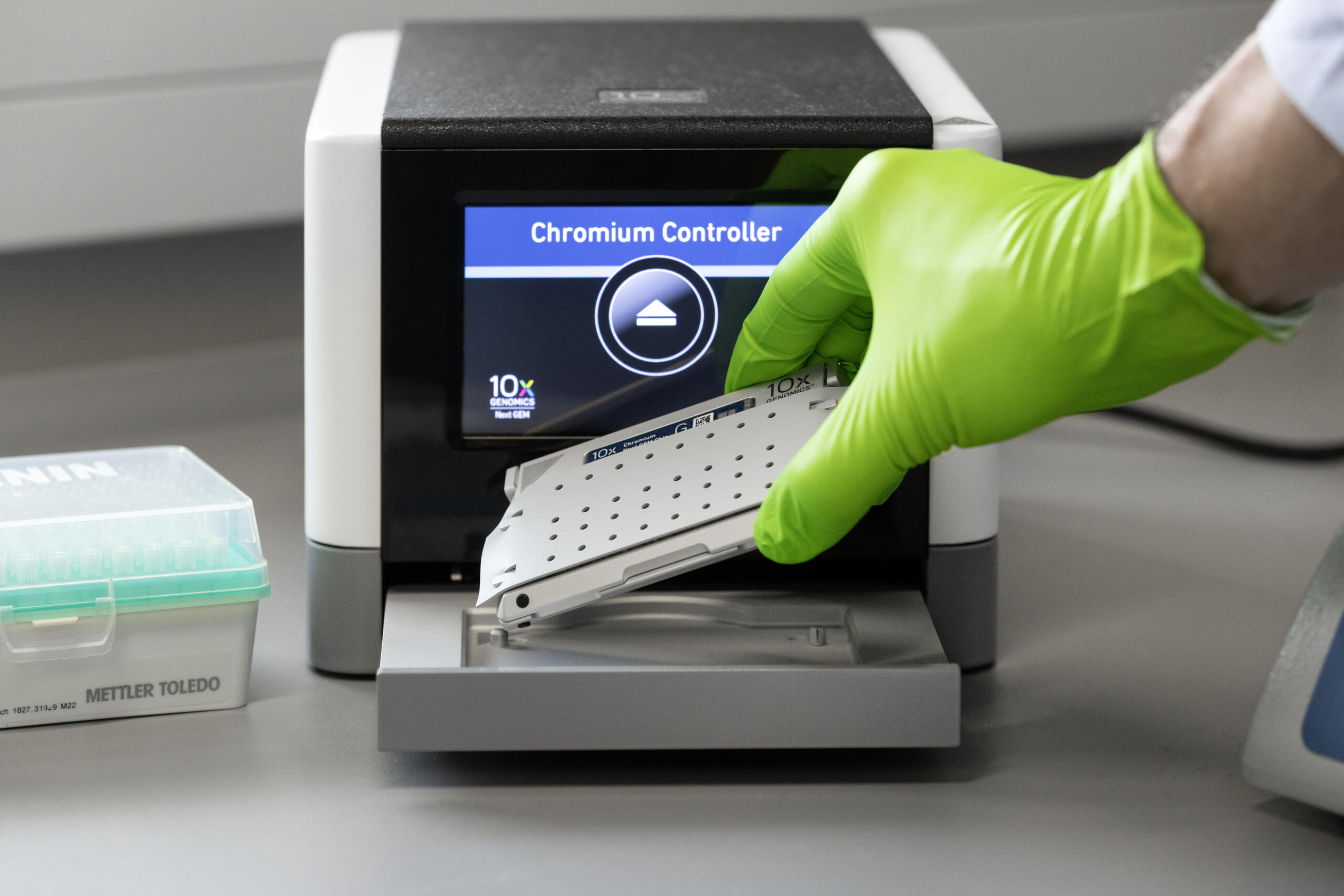
The photo shows the Chromium Controller. In the Chromium Controller, individual cell nuclei are encapsulated in tiny droplets along with reagents, so that the RNA from each cell can later be clearly identified.
The scientists are using DNA analyses to investigate which immune cells drive atherosclerosis, for example. In animals, they are studying early inflammatory mechanisms and analyzing computed tomography images of affected individuals with assistance from machine learning tools. Such analyses can not only detect metastases, but also reveal changes in the coronary arteries.
“Our task will be to determine which genes become active in the cells of the coronary arteries and in the surrounding tissue – in other words, what exactly is happening at the molecular level in the different cell types,” says Dr. Henrike Maatz, a scientist in the Genetics and Genomics of Cardiovascular Diseases lab headed by Professor Norbert Hübner at the Max Delbrück Center. To find out, she will primarily be using two methods: single-nucleus RNA sequencing (snRNA-seq) and spatial transcriptomics.
Research for better quality of life
“For example, we want to characterize more precisely the interaction between immune cells and endothelial cells, which line the inside of blood vessels,” explains Maatz. “Our goal is to understand how immunotherapy promotes T cell-mediated inflammation in blood vessels, which can lead to unstable vascular deposits and atherosclerosis.” Using spatial transcriptomics, she also aims to determine how immune cells are distributed within plaques. The Hector Foundation is supporting the research with about €286,000.
“By bringing together the results generated in the consortium’s different research areas, we aim to identify biomarkers and strategies that make immunotherapy safer – and thereby improve patients’ quality of life,” says project leader Lehmann.
Maatz is looking forward to the upcoming collaboration: “Together, we will of course achieve much more than a single research group could,” she says. “And we have already worked very successfully with Lorenz Lehmann on other projects.”

Contacts
Dr. Henrike Maatz
Genetics and Genomics of Cardiovascular Diseases lab
Max Delbrück Center
Henrike.Maatz@mdc-berlin.de
Jana Schlütter
Deputy Head
Communications and Marketing
Max Delbrück Center
+49 30 9406 – 2118
Jana.Schluetter@mdc-berlin.de or presse@mdc-berlin.de
- Max Delbrück Center
The Max Delbrück Center for Molecular Medicine in the Helmholtz Association lays the foundation for the medicine of tomorrow through our discoveries of today. At locations in Berlin-Buch, Berlin-Mitte, Heidelberg, and Mannheim, interdisciplinary teams investigate the complexity of disease at the systems level – from molecules and cells to organs and entire organisms. Together with academic, clinical, and industry partners, and as part of global networks, we turn biological insights into innovations for early detection, personalized therapies, and disease prevention. Founded in 1992, the Max Delbrück Center is home to a vibrant, international research community of around 1,800 people from over 70 countries. We are 90 percent funded by the German federal government and 10 percent by the state of Berlin.


