
How blood stem cells diversify
Joint press release from the Max Delbrück Center and the Berlin Institute of Health at Charité (BIH)
Every day, the body produces vast numbers of blood and immune cells –all of them from stem cells located in bone marrow. Scientists have long known that these stem cells have diverse characteristics — for example, they differ in how quickly they divide or in the specific types of cells they become. But exactly how this diversity arises and why it matters has remained unclear.
Now, a team led by three researchers from Heidelberg and Berlin scientist Dr. Simon Haas provides the first coherent explanation for this phenomenon in “Nature Cell Biology.” According to the study, there are no fixed subgroups of blood stem cells in the bone marrow.
Instead, all stem cells change along a predefined developmental path: from a slow, highly potent state to a more active state, but with more limited developmental potential. “A better understanding of stem cell behavior could help make therapies based on these cells, such as treatments for leukemia, more effective,” says Haas.
Biological experiments and mathematical models
Haas leads a research group in the joint research focus Single-Cell Approaches for Personalized Medicine at the Berlin Institute of Health in the Charité (BIH), the Max Delbrück Center, and Charité – Universitätsmedizin Berlin. He is also Professor of Single-Cell Technologies and Precision Medicine at the Precision Healthcare University Research Institute at Queen Mary University of London. His laboratory is based at the Berlin Institute for Medical Systems Biology of the Max Delbrück Center (MDC-BIMSB).
Haas is one of four senior authors of the current study. Together with Dr. Michael Milsom of the German Cancer Research Center (DKFZ) and the Heidelberg Institute for Stem Cell Technology and Experimental Medicine (HI-STEM), he was primarily responsible for the experimental part of the work. The two other senior authors — Dr. Daniel Hübschmann of the National Center for Tumor Diseases Heidelberg, DKFZ, and Heidelberg University, and Dr. Thomas Höfer of DKFZ — carried out the mathematical modeling that helped the team reach its conclusions.
A shared pathway
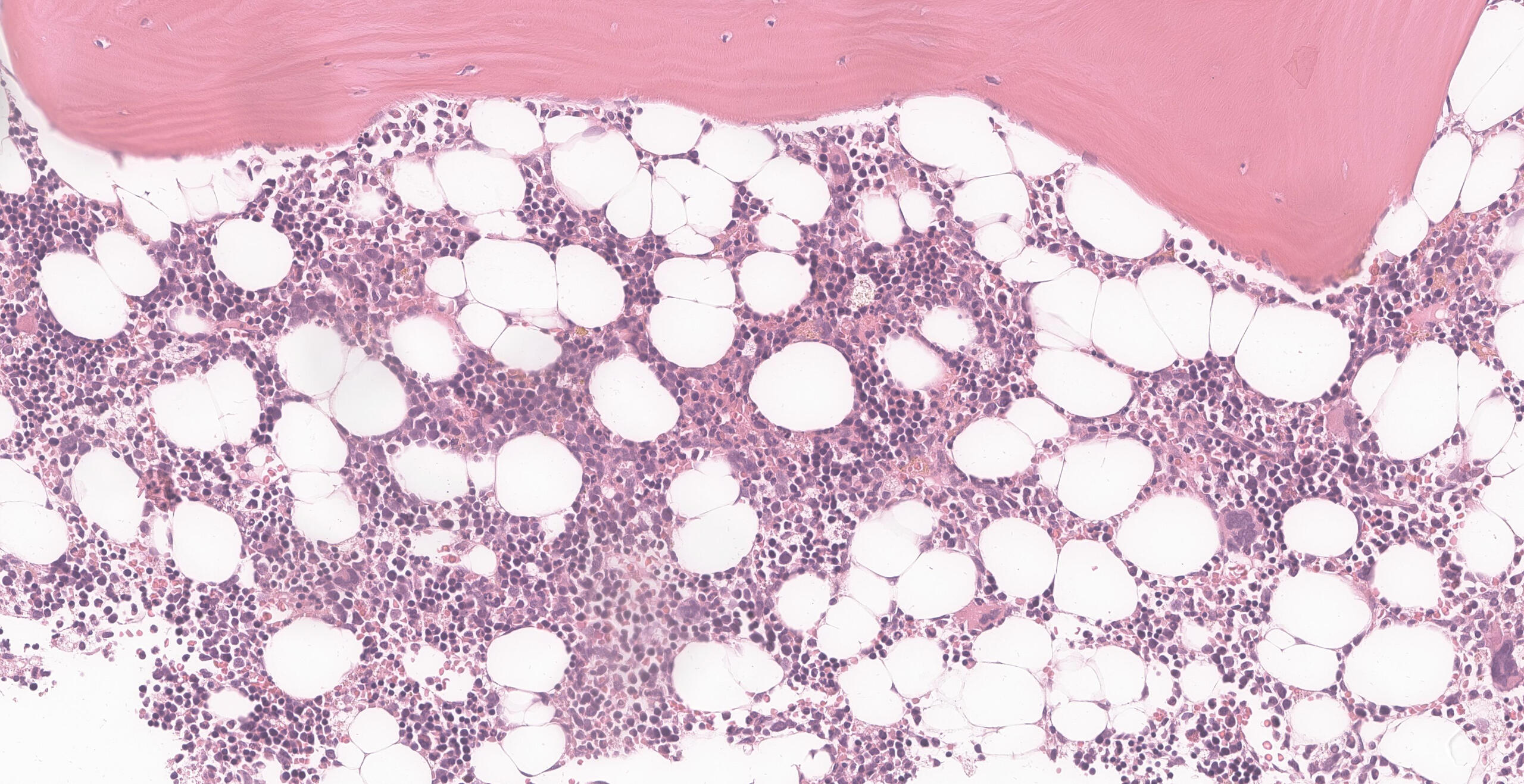
Microscopic image of a bone marrow biopsy: Stem and progenitor cells as well as mature blood and immune cells (stained purple) can be seen between the bone trabeculae (pink) and fat cells (white).
“To find out how the diversity of blood stem cells arises, we isolated more than a thousand of these cells individually, labeled each one with a fluorescent protein, and then transplanted them into mice,” explains Dr. Florian Grünschläger, a former doctoral student in the Haas lab and one of the study’s three first authors. “This allowed us to track their development in the animals and observe which blood and immune cells emerged from them, when they appeared, and in what quantities.”
By combining high-resolution single-cell technologies with mathematical modeling, the researchers discovered a surprising pattern: All blood stem cells develop along a shared trajectory. At first, they divide and differentiate only slowly, but over time they become faster and more active. As they progress along this path, not only does the speed of cell production change, but also the types of blood and immune cells they predominantly generate. The stem cells cannot reverse course once they have progressed along this path.
Blood stem cells compete
“One key finding of our study is that stem cells do not act in isolation,” says Dr. Esther Rodríguez Correa, another first author and former doctoral researcher in the Milsom lab. “Instead, slow and fast cells compete with one another to produce the different mature blood and immune cells.” Which cells are ultimately produced depends partly on the developmental stage of the stem cell and partly on the body’s current needs.
“The competition between stem cells, along with several feedback signals from the body — for example in the form of cytokines — determines the final outcome,” explains Haas. “It ensures that the proper balance between different blood and immune cells is maintained while also allowing the body to respond rapidly to stress, such as an infection or major blood loss.”
Haas and his colleagues believe that many of the findings in mice can be extrapolated to humans. “At the very least, they explain numerous observations in the human blood and immune system,” says Haas. “If we gain a more detailed understanding of how blood-forming stem cells behave in the body, we will also be able to better predict and control their behavior in patients.” Stem cell therapies and bone marrow transplants, which have long been used to treat leukemia and other blood disorders, could thus become more refined and more effective.
Text: Anke Brodmerkel
Further information
- Haas lab (MDC-BIMSB)
- Haas lab (BIH)
- Single-cell approaches for personalized medicine
- How immune cells communicate
Literature
Esther Rodríguez Correa, Florian Grünschläger, Tamar Nizharadze, et al. (2026): “A kinetics-based model of haematopoiesis reveals extrinsic regulation of skewed lineage output from stem cells.” Nature Cell Biology, DOI: 10.1038/s41556-026 – 01958‑0
Image for download
Microscopic image of a bone marrow biopsy: Stem and progenitor cells as well as mature blood and immune cells (stained purple) can be seen between the bone trabeculae (pink) and fat cells (white).
© Dr. Jana Ihlow, Charité – Universitätsmedizin Berlin
Contacts
Dr. Simon Haas
Group Leader, Systems Hematology, Stem Cells & Precision Medicine
MDC-BIMSB and BIH
Simon.Haas@mdc-berlin.de or simon.haas@bih-charite.de
Jana Schlütter
Deputy Head
Communications & Marketing
Max Delbrück Center
+49 30 9406 – 2118
Jana.Schluetter@mdc-berlin.de or presse@mdc-berlin.de
Olé Kamm
Editor and Press Officer
Communications
BIH
olé.kamm@bih-charite.de
- Max Delbrück Center
The Max Delbrück Center for Molecular Medicine in the Helmholtz Association lays the foundation for the medicine of tomorrow through our discoveries of today. At locations in Berlin-Buch, Berlin-Mitte, Heidelberg, and Mannheim, interdisciplinary teams investigate the complexity of disease at the systems level – from molecules and cells to organs and entire organisms. Together with academic, clinical, and industry partners, and as part of global networks, we turn biological insights into innovations for early detection, personalized therapies, and disease prevention. Founded in 1992, the Max Delbrück Center is home to a vibrant, international research community of around 1,800 people from over 70 countries. We are 90 percent funded by the German federal government and 10 percent by the state of Berlin.
- Berlin Institute of Health at Charité (BIH)
The Berlin Institute of Health at Charité (BIH) is dedicated to biomedical translation. Its mission is to translate research findings into personalized prevention, diagnostics, and therapies to benefit patients and provide the scientific community with effective tools. With approximately 750 employees, the BIH specializes in translational method development, precision medicine, regenerative therapies, and biomedical data science. Closely integrated with Charité, the BIH promotes excellent research and facilitates the accelerated transfer of new discoveries into clinical practice through its supporting platforms and programs. Through these efforts, the BIH builds strong partnerships and fosters innovation-driven medicine in both national and international contexts.


