
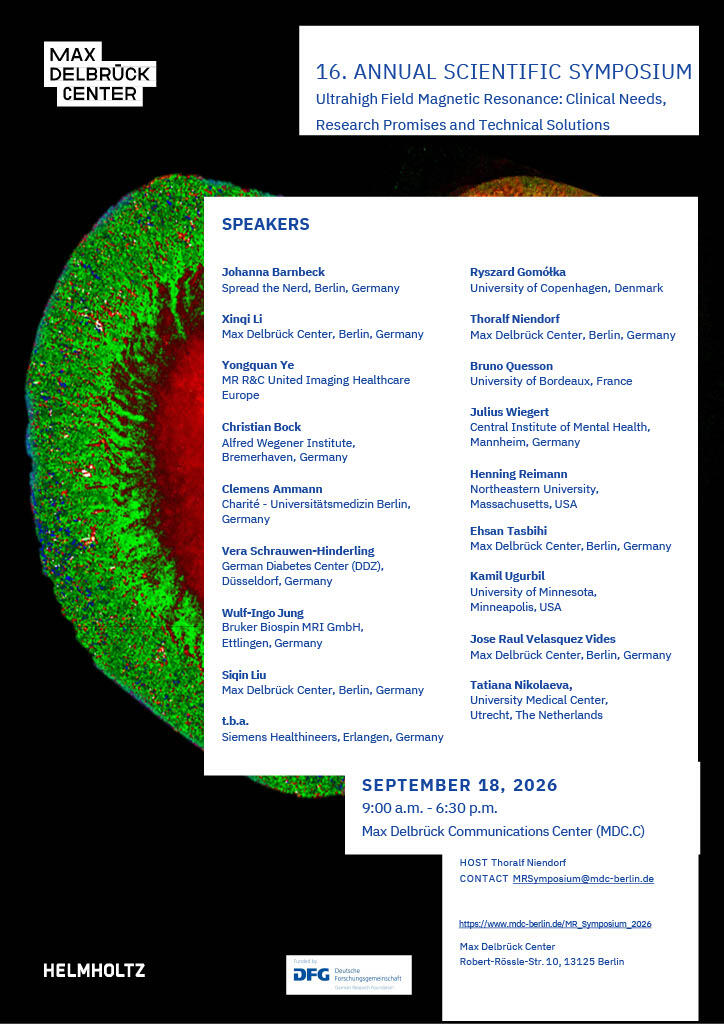
16. Annual Scientific Symposium Ultrahigh Field Magnetic Resonance: Clinical Needs, Research Promises and Technical Solutions
Dear colleagues and friends,
Great thanks for your interest in the 16th Scientific Symposium on Clinical Needs, Research Promises and Technical Solutions in Ultrahigh Field Magnetic Resonance, taking place in Berlin on September 18th 2026.
Imaging provides a unique bridge across scales and time in life science and medicine—from molecular and cellular processes to whole-body function, and from ultrafast biological events to long-term population studies. By combining imaging with data science, we can transform complex observations into a more integrated understanding of tissues, organs, and organisms, enabling earlier disease detection and intervention.
Magnetic resonance has evolved rapidly over the past decades, enabling an expanding range of applications in basic, translational and clinical research. At the same time, increasingly complex and high-dimensional imaging datasets have made data science indispensable to modern MRI research. Artificial intelligence (AI) is now transforming image reconstruction, acquisition, automated analysis, quantitative biomarker development and the integration of imaging with clinical and molecular data.
These advances offer new opportunities for earlier disease detection, improved patient stratification, and more precise monitoring of disease progression and treatment response. Advancing this field requires interdisciplinary collaboration, international partnerships, and a shared vision that connects technology, biological understanding, and clinical impact.
The symposium will bring together life scientists, engineers, data scientists and clinicians at all career stages, from students and trainees to advanced users, or technical experts to discuss current clinical needs, emerging research opportunities and innovative technical solutions in MRI. It is a platform for interdisciplinary exchange, new collaborations and discussion of how data science and AI can help shape the future of imaging research.
- Scientific Program
The scientific program comprises 4 sessions, all balancing technical developments, clinical applications and hot topics related to the synergies between imaging and data science. The scientific program is designed to lay extensive bridges between disciplines to enable the translation of multimodal AI technology into clinically-relevant imaging guided diagnostics, therapy monitoring and digital health applications. We are very much honored to present extraordinary speakers including MR technology leaders, data science specialists and distinguished clinical experts - all bridging disciplinary boundaries and stimulating the imaging and data science communities to throw further weight behind the solution of unsolved problems and unmet clinical needs.
- Scientific Session I
- GETTING TO THE HEART OF THE MATTER: CLINICAL NEEDS AND RESEARCH PROMISES OF CARDIOVASCULAR, BODY AND METABOLIC MR
09:00 WELCOME Thoralf Niendorf & Min-Chi Ku, Berlin, Germany KEYNOTE LECTURE 09:10 Seeing the Unseen: Magnetic Resonance
Imaging at 10.5 TKamil Ugurbil, University of Minnesota, Minneapolis, USA SCIENTIFIC SESSION I Chairs:
Jutta Ellermann, Minneapolis, USA
Min-Chi Ku, Berlin, GermanyGETTING TO THE HEART OF THE MATTER: CLINICAL NEEDS AND RESEARCH PROMISES OF CARDIOVASCULAR, BODY AND METABOLIC MR 09:40 Taking the Strain: Assessment of Myocardial Fiber Function at 7.0 T and 3.0 T Siqin Liu, Max Delbrück Center, Berlin, Germany 10:00 UHF Clinical Imaging Outside the Brain with 5T MRI Yongquan Ye, MR R&C United Imaging Healthcare Europe 10:20 Insights from the German National Cohort: Native T1 Mapping of the Heart Reveals Associations with Sex, Age and Cardiometabolic Risk Factors Clemens Ammann, Charité-Universitätsmedizin, Berlin, Germany 10:40 Magnetic Resonance Spectroscopy Applications in Diabetes Research Vera Schrauwen-Hinderling, German Diabetes Center (DDZ), Düsseldorf, Germany 11:00 Poster Power Session (3 x 3 min) 11:10 PANEL DISCUSSION: CARDIAC AND BODY MRI at UHF 11:25 COFFEE BREAK / RELAXATION WITH LIVE MUSIC
- Scientific Session II
- GETTING TO THE MATTER OF THE BRAIN: CLINCAL NEEDS AND RESEARCH PROMISES FOR NEUROVASCULAR UHF-MR AND RELATED FIELDS
Chairs:
Bruno Quesson, Bordeaux, France
Sonia Waiczies, Berlin, Germany11:45 Looking for Central Vein Signs: Simultaneous T2, T2*, and R2′ Mapping for Multiple Sclerosis Using Nonlinear Model-Based Reconstruction Jose Raul Velasquez Vides, Max Delbrück Center, Berlin, Germany 12:05 Artificial Intelligence in Brain MRI: Insights into Depression, Anxiety, and Alcohol Use from the German National Cohort Julius Wiegert, Central Institute of Mental Health, Mannheim, Germany 12:25 Hot, Cold, and BOLD fMRI at 7.0 T: Thermal Signal Processing in the Insular Cortex Follows Architectural Principles Henning Reimann, Northeastern University, Boston, MA, USA 12:45 Mapping Brain Microstructure Beyond the Human Brain: Diffusion UHF-MRI of Living Cortical Organoids Tatiana Nikolaeva, University Medical Center Utrecht, The Netherlands 13:05 Poster Power Session (3 x 3 min) 13:15 PANEL DISCUSSION: BRAIN MRI at UHF 13:30 LUNCH BREAK
- Scientific Session III
- TRANSLATIONAL RESEARCH: FROM BLUE SKY EXPLORATIONS EN ROUTE TO CLINICAL APPLICATIONS
Chairs:
Vera Schrauwen-Hinderling, Düsseldorf, Germany
Philipp Boehm-Sturm, Berlin, Germany14:15 k-Space Encounters – Where Art & Science Become MRI Techno Johanna Barnbeck, Spread the Nerd, Berlin, Germany 14:35 Sea to Summit: Progress in Preclinical MR at Ultrahigh and Extreme Magnetic Fields Wulf-Ingo Jung, Bruker Biospin MRI GmbH, Ettlingen, Germany 14:55 Unmasking Brain Fluid Dynamics under Awake Conditions: The Path to Translation Ryszard Gomółka, University of Copenhagen, Denmark 15:15 Integrative Ecophysiology: MRI and MRS in View of Climate Change Christian Bock, Alfred Wegener Institute, Bremerhaven, Germany 15:35 Guardian of the Body's Inner Ocean: Probing the Tubule System with Quantitative MRI from Experimental Models to Humans Ehsan Tasbihi, Max Delbrück Center, Berlin, Germany 15:55 Poster Power Session (3 x 3 min) 16:05 PANEL DISCUSSION: TRANSLATIONAL MRI AT UHF 16:20 COFFEE BREAK / RELAXATION WITH LIVE MUSIC
- Scientific Session IV
- LOOKING AT THE HORIZON
Chairs:
Wulf-Ingo Jung, Ettlingen, Germany
Jason Millward, Berlin, Germany16:45 The Invisible Heat, Revealed: Ultrafast MR Thermometry for Monitoring of Thermal Therapy Bruno Quesson, University of Bordeaux, France 17:05 Beyond: Metamaterial Antennas Enhance MRI of the Eye and Brain at 7.0 T Thoralf Niendorf, Max Delbrück Center, Berlin, Germany 17:25 From Physics to Learning: Trustworthy AI as a bridge in Quantitative MRI Xinqi Li, Max Delbrück Center, Berlin, Germany 17:45 Nova Terra: Progress in Clinical Ultrahigh Field MRI at 7.0 T t.b.a., Siemens Healthineers, Erlangen, Germany 18:05 PANEL DISCUSSION: FUTURE OF UHF MRI 18:20 AWARDS & ADJOURN
- Poster sessions
The scientific program will be paralleled by a poster session where all posters are made available electronically. We are looking forward to your poster contributions which will be all considered for the symposium’s poster price contest. We wish to encourage those of you who are courageous to walk the extra mileage. We have included numerous slots of 3 min speedy poster power presentations into the program. This will give a large number of poster presenters the opportunity to be in the spotlight of the audience.
- Important Dates
Abstract Submission Deadline: Friday, September 04th 2026, 06:00 p.m. CEST
Registration deadline: Friday, September 11th 2026, 06:00 p.m. CEST
- Information
CONFERENCE OFFICE:
Carolin Bechtloff
Max Delbrück Center for Molecular Medicine in the Helmholtz Association (MDC)
Robert-Rössle-Straße 10
13125 BerlinE-Mail: E-Mail: MRsymposium@mdc-berlin.de
Venue
Max Delbrück Center
Robert-Rössle-Straße 10
Axon 1 and Online via Zoom
13125 Berlin
Deutschland
Zeit
Organisator*innen
Thoralf Niendorf (MDC & Charité, Berlin)
Lucio Frydman (Weizmann Institute of Science, Rehevot)
Michal Neeman (Weizmann Institute of Science, Rehevot)
Min-Chi Ku (MDC, Berlin)
Sonia Waiczies (MDC, Berlin)
Christoph Lippert (HPI, Potsdam)