
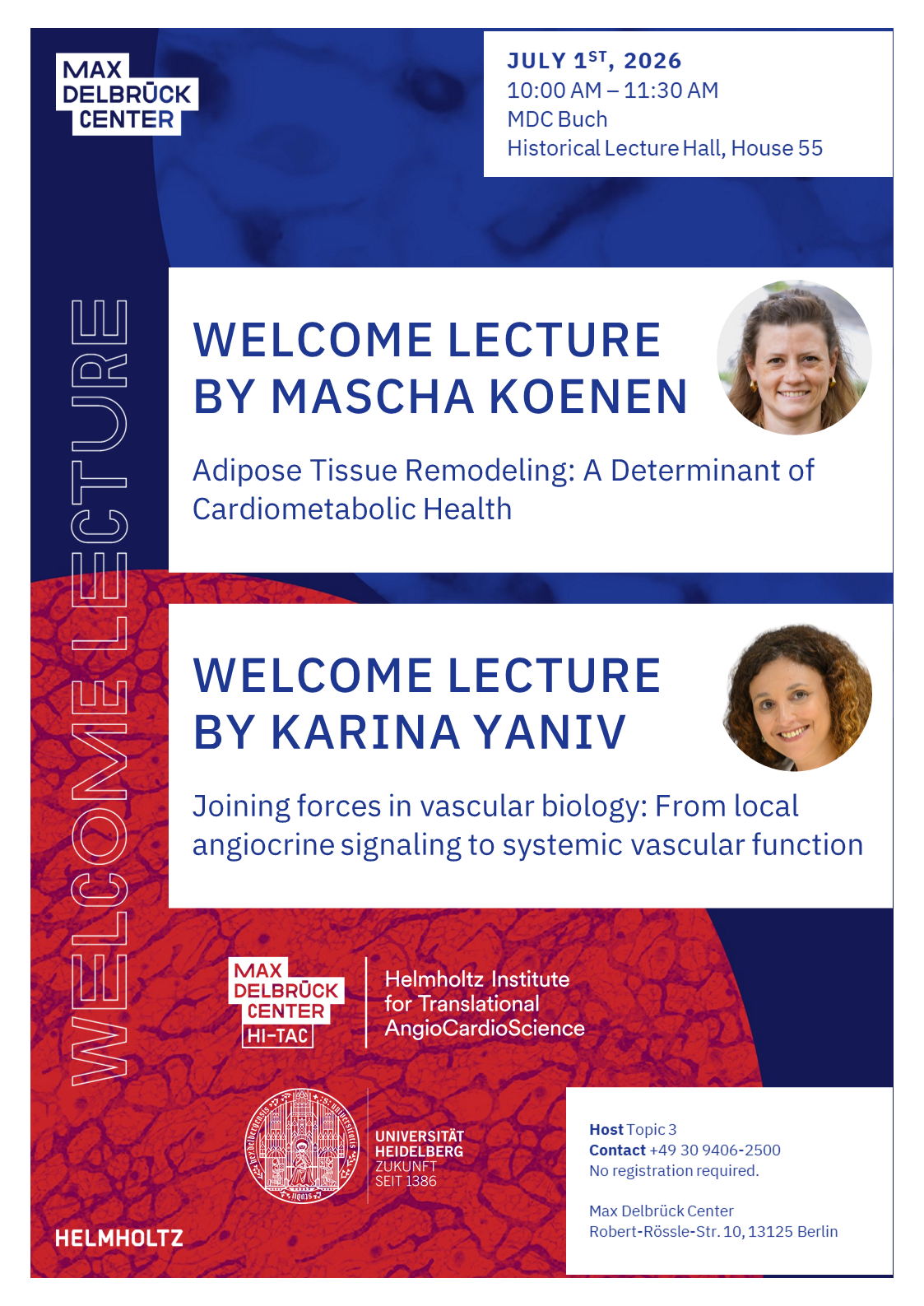
Welcome Lectures by Karina Yaniv and Mascha Koenen from HI-TAC
Speaker:
Dr. Masha Koenen
Title:
Adipose Tissue Remodeling: A Determinant of Cardiometabolic Health
Abstract:
Adipose tissue is a highly plastic endocrine organ with profound effects on whole-body physiology. Excess adipose tissue accumulation in obesity affects more than one billion people worldwide and is associated with severe comorbidities. Although recent breakthroughs have provided unprecedented treatment options for obesity, many individuals discontinue therapy, making weight regain and the subsequent recurrence of comorbidities an increasingly important clinical challenge.
The dynamic expansion and retraction of adipose tissue in response to weight fluctuations require substantial remodeling of the tissue’s architecture. This process is orchestrated by intricate communication networks that govern tissue function and organ crosstalk, yet the underlying molecular mechanisms and cellular interaction partners remain poorly understood. We showed that manipulation of adipocyte identity alone, independent of obesity, is sufficient to induce tissue fibrosis, alter vascular reactivity, and increase blood pressure. This discovery demonstrates that local tissue remodeling has a profound impact on cardiovascular risk and systemic comorbidities.
We will leverage the diversity of adipose tissue depots, each characterized by distinct microenvironments, endocrine functions, and cardiovascular risk associations, to identify tissue-specific vulnerabilities and resilience mechanisms. By defining shared communication networks and depot-specific reorganization programs that distinguish adaptive from maladaptive remodeling, we aim to uncover fundamental determinants of cardiovascular risk and disease susceptibility.
-
Speaker:
Prof. Dr. Karina Yaniv
Title:
Joining forces in vascular biology: From local angiocrine signaling to systemic vascular function.
Abstract:
Endothelial cells (ECs), which line the inner surfaces of blood and lymphatic vessels, play a crucial role in maintaining tissue health, guiding organ formation during embryonic development, supporting tissue regeneration, and mediating responses to pathological conditions. Recent advances in single-cell technologies have revolutionized our understanding of EC heterogeneity. Nevertheless, the ways in which vessels communicate with their surrounding microenvironments across different tissues, vessel types, and pathophysiological states remain largely underexplored.
Over the past few years, my lab has used the zebrafish (ZF) model to investigate the molecular and cellular mechanisms controlling blood and lymphatic vessel formation, as well as the instructive role the vasculature plays during organogenesis. Our studies have uncovered unexpected developmental origins for lymphatic endothelial cells, challenged traditional models of lymphangiogenesis, and identified the molecular cues that drive organ-specific vascular networks in the liver, pancreas, and intestine. We have also revealed novel mechanisms of vascular plasticity, including blood vessel formation through lymphatic-to-blood endothelial transdifferentiation in the regenerating fin.
EC heterogeneity is highly relevant not only to organ growth and regeneration but also to vascular malformations and malfunctions of the cardiovascular system. It is within this context that we have established zebrafish models of vascular malformations. Leveraging the optical transparency, genetic accessibility, and suitability of zebrafish for high-throughput drug screening, we utilize this system to investigate disease mechanisms in vivo and to identify candidate therapeutic compounds. Finally, ECs represent the main component of stem cell niches, supporting their maintenance, expansion, and controlling their differentiation.
By defining the principles that govern endothelial specialization and plasticity, our research bridges the gap between fundamental vascular biology and translational applications, aiming to inform strategies for repairing and reprogramming vascular networks in disease.
-
Zoom Link upon request (T3admin@mdc-berlin.de)
Host: Topic 3 & HI-TAC Management
Venue
Max Delbrück Center, Campus Buch
Robert-Rössle-Straße 10
Haus 55, Historic Lecture Hall
13125 Berlin
Deutschland