
Optogenetics
The technique has been developed over the past decade by Deisseroth et al. and allows us now to study universal behaviors, such as sensation, movement, cognition, and emotion that arise from the interaction of specific neural networks in the brain. With this toolbox we will probe the BSX neuronal network that is integrated into the hypothalamus to modulate and understand its role in the regulation of behavioral and metabolic pathways.
BSX and Optogenetics
The brain specific homeobox transcription factor BSX is one of the evolutionary highest conserved homeobox proteins among Drosophila, C. elegans, fish and mammals exclusively expressed in the brain and in mammals particularly in the hypothalamus. We have reported that BSX is required for locomotory behavior, hyperphagia and expression of the hypothalamic neuropeptides NPY and AgRP, which regulate feeding behavior and body weight. Mice lacking BSX exhibit reduced locomotor activity and lower expression of NPY and AgRP. They also exhibit attenuated physiological responses to fasting, including reduced increase of NPY/AgRP expression, lack of food-seeking behavior and reduced rebound hyperphagia. Furthermore, BSX gene disruption rescues the obese phenotype of leptin-deficient ob/ob mice by reducing their hyperphagia without increasing their locomotor activity. (Sakkou et al.).
Thus, BSX represents an essential factor for NPY/AgRP neuronal function and locomotory behavior in the control of energy balance.
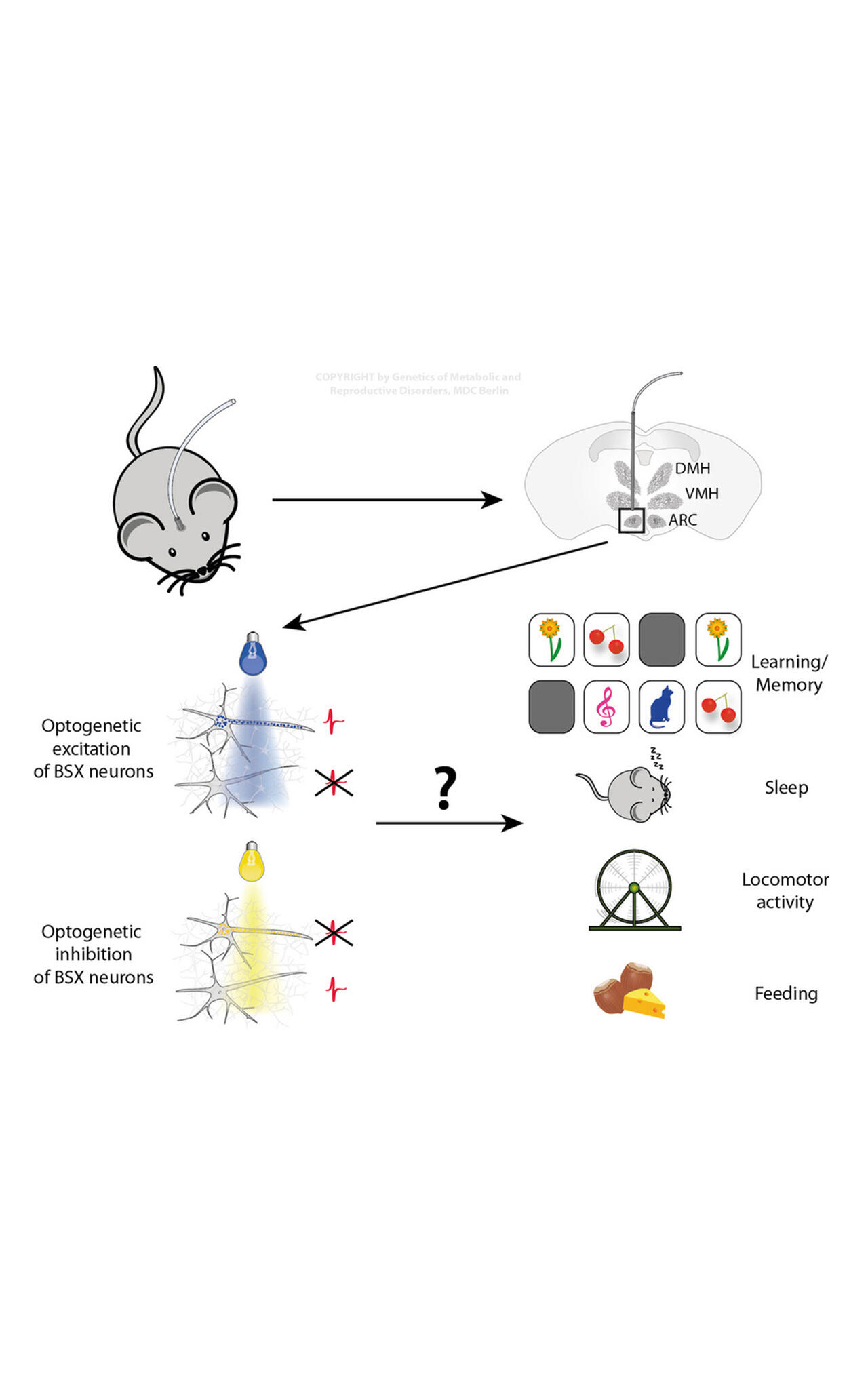
How to discover BSX function with Optogenetics
For us, the most fundamental question right now is to elucidate the molecular mechanisms that allow the BSX hypothalamic network to coordinate the dialogue between arousal and metabolic pathways. We want to characterize in detail the contributions of the different BSX neuronal subpopulations throughout the hypothalamus.
Experimentally, our studies will rely on the generation of novel mouse models with conditional inactivation of BSX itself or its identified targets in subpopulations of the BSX neuronal network. Subsequently, we will analyze the consequences of their altered expression with respect to feeding bahvior and sleep.
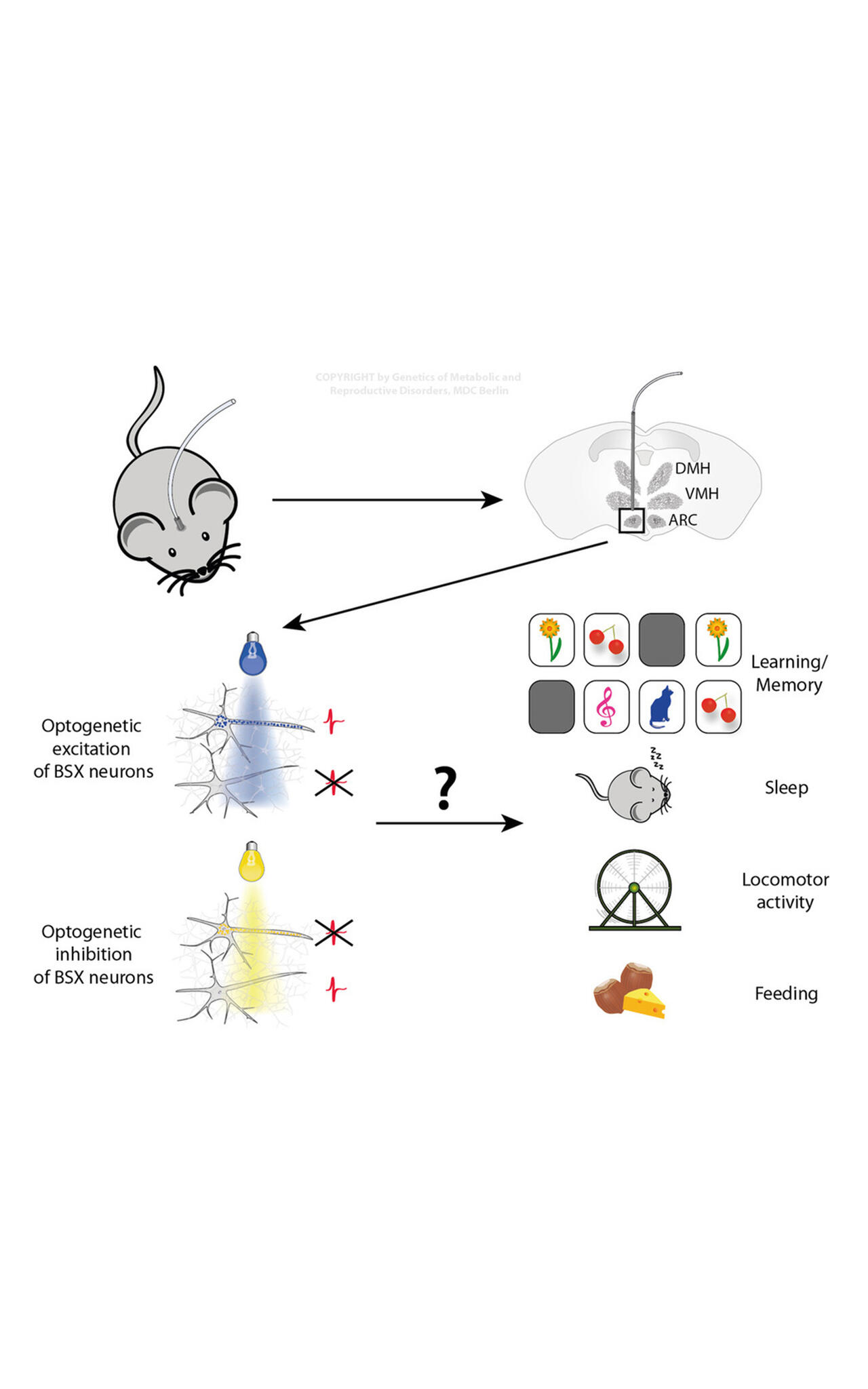
An important aspect of our work will rely on optogenetic approaches, which will allow us to stimulate or inhibit the BSX neuronal network in its entirety or only in subpopulations (see cartoon below). In this respect, we will also challenge the BSX-deficient neuronal network by dietary stressors including high fat and carbohydrate-rich diets to explore their impact on neuronal excitablity.
This work is part of the Helmholtz Alliance ICEMED (Imaging and Curing Environmental MEtabolic Diseases).
